Blue Springs Tree Removal has been doing tree trimming and pruning across Blue Springs, MO for more than twenty years, serving surrounding cities including Grain Valley, Independence, Oak Grove, Lee’s Summit and Raytown. Pruning is the work that decides whether a tree becomes a removal in ten years or stays a tree for another forty, and it is also the service most often sold with no stated objective at all.
We name the objective before we cut. Clearing a roof line, taking end weight off a leader hanging over a driveway, opening a crown that has grown into a solid sail, removing the dead wood after a hot summer: each of those is a different job with different cuts, and lumping them together as trimming is how a tree ends up with a third of its canopy on the ground and no plan behind it.
Everything we do is cut to the ANSI A300 pruning standard, using natural target pruning. We do not top trees, and if somebody has quoted you a height reduction that sounds like topping described politely, we will tell you what it actually does to the tree and price the alternative instead.
The Four Pruning Jobs, Named
Crown Cleaning
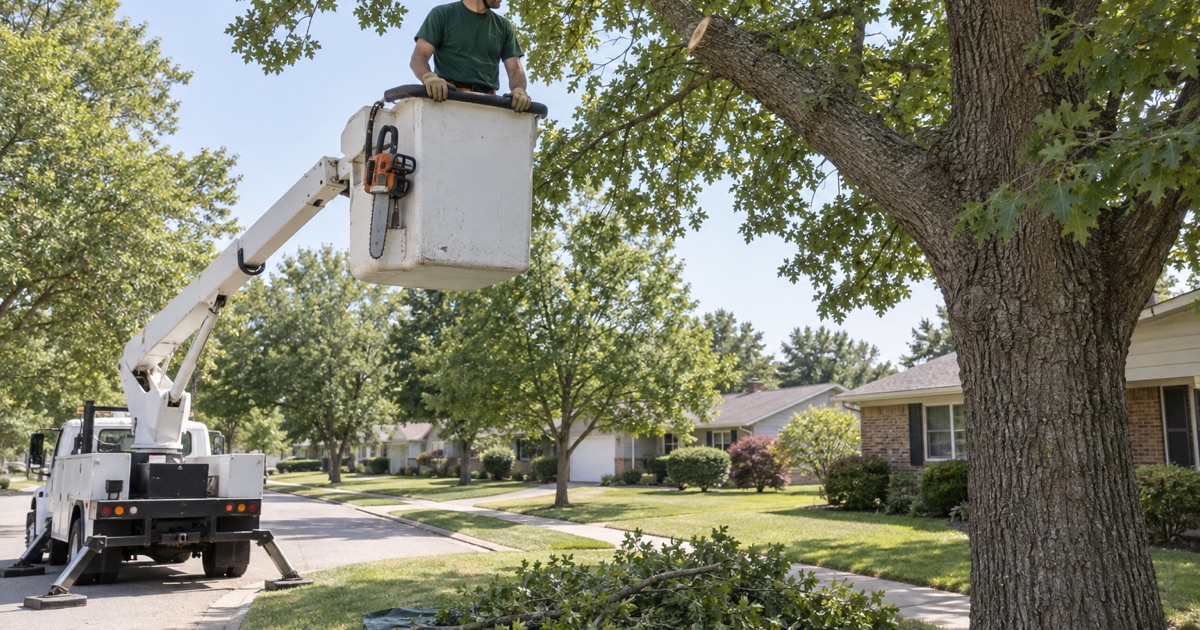
Crown cleaning removes dead, dying, diseased, broken and crossing wood, and nothing else. It is the lowest-risk pruning there is, because no live photosynthetic capacity leaves the tree, and it is the one most mature yard trees actually need. It also doubles as an inspection: a climber working through a canopy finds the seams, cankers and included-bark unions that are invisible from the lawn.
Crown Raising
Raising lifts the lowest limbs to clear a roof, a drive, a walk or a sight line. The constraint is that a tree needs its lower canopy to build trunk taper, so raising a young tree hard leaves a permanent lollipop that never develops the strength it should have. On a mature tree the limits are different: the cuts get larger, and a large cut on an old limb is a wound the tree may not close.
Crown Reduction
Reduction shortens leaders and limbs back to a lateral branch large enough to assume the terminal role, which is what makes it pruning rather than topping. It is the correct answer to a tree that has outgrown its space or a limb with too much end weight over a target, and it is slower and more expensive than topping precisely because every cut has to be placed at a specific point on a specific branch.
Crown Thinning
Thinning removes selected branches throughout the canopy to reduce density and let wind pass, without changing the tree’s size or outline. Done lightly, it takes load off a marginal union. Done heavily, it strips the interior, leaves all the foliage at the ends of long limbs, and makes the failure it was meant to prevent more likely, which is why thinning is the pruning job most often overdone.
Structure, Defects and Cabling
Co-Dominant Stems and Included Bark
Two leaders of similar diameter meeting at a narrow union trap bark between them, and that included bark never knits into wood. The joint holds on friction and geometry until a loaded wind event finds it, and then a third of the tree lands somewhere. Corrected early with subordination pruning it is a minor job; found late, it is a cable, a brace rod, or a removal.
Cabling, Bracing and What They Buy
Extra-high-strength cable installed high above a weak union redistributes load between leaders, and a Cobra dynamic cabling system does the same with a synthetic line that allows some movement so the tree keeps building reaction wood. A brace rod through a union that has already begun to separate carries what a cable alone cannot. None of it is permanent hardware to install and forget: cabled trees need looking at on a stated interval.
Reading a Tree Before Pruning It
A pruning plan starts from what is wrong with the tree, not from what looks untidy. Conks at the base, heartwood decay behind an old wound, epicormic sprouts along a trunk, a root plate lifting on one side: any of those changes the answer from prune to assess, and sometimes from assess to remove. We would rather tell you that before you have paid for a pruning that was never going to help.
Timing, Species and the Local Calendar
The Dormant Season Is the Default
With the leaves off, structure is visible, weight is off the limbs, and cuts made in late winter close quickly once growth resumes. That is when most of the structural work on this site’s territory gets scheduled. Dead wood and storm damage are exceptions and come out whenever they appear, because a hanging limb does not wait for a season.
Pine Wilt Is the One Real Deadline
Kansas State Research and Extension publication L722 records that Scots pine plantings in eastern Kansas have been devastated by pine wilt, that symptoms show from August through December, and that an affected tree should be cut down as soon as possible or by May 1 at the latest, with April 1 better. It also says to cut the tree to the ground rather than leaving a stump, to chip or burn the wood immediately, and not to save it for firewood.
The Species That Generate the Calls
Much of the pruning demand in this metro sits on trees the land-grant authority tells people not to plant. K-State Research and Extension’s Johnson County guide for metropolitan Kansas City instructs, in terms, not to plant the Bradford cultivar because severe splitting occurs on trees ten to fifteen years old, and its not-recommended list also names silver maple for weak wood, pin oak, green ash, Austrian pine, Scotch pine, box elder, Lombardy poplar, Siberian elm and willow.
What Leaves With Us, and What Stays
The Brush Does Not Sit at Your Curb
Blue Springs runs no curbside brush program, and the city’s bundle rule stops at limbs under four inches tied into bundles no longer than forty-eight inches and under seventy-five pounds. A pruning job produces material well past that on both counts, so it leaves on our chipper truck. Under RSMo 260.250 yard waste has been barred from Missouri disposal areas since 1992, so it goes to a composting gate, and the routing is named in your quote.
Chips, Firewood and the Things Worth Keeping
If you want the chips for beds, say so and we will blow a load where you want it instead of hauling it. If you want the trunk wood in rounds, that comes off the disposal side of the quote as a stated credit rather than as a favor, because cutting to a length you can handle and stacking it where you want it is crew time. Either way it is a line you can see.
The Yard After the Crew Leaves
Rigging a limb down over a lawn, a bed or a fence is what most of the day actually consists of, and it is done with a bull rope through a Port-a-Wrap friction device rather than by dropping weight and hoping. Ropes, mats and a marked drop zone are why the turf under a pruning job usually looks untouched afterward, and why we do not work aloft in gusts.
- 20+ Years in the KC Metro
- Free On-Site Assessment
- Written Price, Insured Crews