Blue Springs Tree Removal handles tree disease treatment and plant health care across Blue Springs, MO, serving surrounding cities including Grain Valley, Independence, Oak Grove, Lee’s Summit and Raytown. The useful part of this service is rarely the treatment. It is the diagnosis, because a large share of the trees people call about as diseased are not sick in any way a spray would reach.
The housing stock in this territory is the reason. Yards planted with the subdivisions are now mature, and they were planted heavily with species the regional extension services have since told people not to use. When one of those declines on schedule, the honest answer is often that the tree is doing exactly what its species does at that age, and that a treatment program will not change it.
So we start with a look at the root collar, the soil, the structure and the crown, in that order, and we name what we find. Where there is a real pathogen or pest with a real response, we say what it is and what the response involves. Where the answer is a removal with a deadline attached, we say that too, and we say when.
The Pests and Diseases That Actually Show Up Here
Pine Wilt Has a Calendar, Not a Cure
Pine wilt, carried by the pine wilt nematode, is the one condition in this trade with a hard date attached. Kansas State Research and Extension publication L722 records that Scots pine plantings in eastern Kansas have been devastated and that Austrian pines have been affected in recent years, and it is specific about the response: down as soon as possible, May 1 at the latest and April 1 better, cut to the ground with no stump, and the wood chipped or burned immediately rather than saved for firewood.
Emerald Ash Borer and the Ash Question
Emerald ash borer was discovered in Missouri in July 2008 in Wayne County, and the federal domestic quarantine was removed effective January 14, 2021. The practical decision on any given ash is whether it is worth a program: a sound tree with a full crown in a spot that matters can be, while a thinning one is a removal being deferred. Whichever way it goes, the wood of a dead ash goes brittle fast, and that changes the cost of taking it down.
Needle Blights on Ornamental Pines and Spruce
Dothistroma needle blight and Diplodia tip blight are the two needle and shoot diseases that turn up on the ornamental conifers planted through this metro, and they present very differently from pine wilt even though the homeowner’s description is often identical. Getting that distinction right is the whole visit, because one is a management problem and the other is a dated removal, and treating the second as the first wastes the only window there was.
Decline That Is Not a Disease at All
The Buried Root Flare
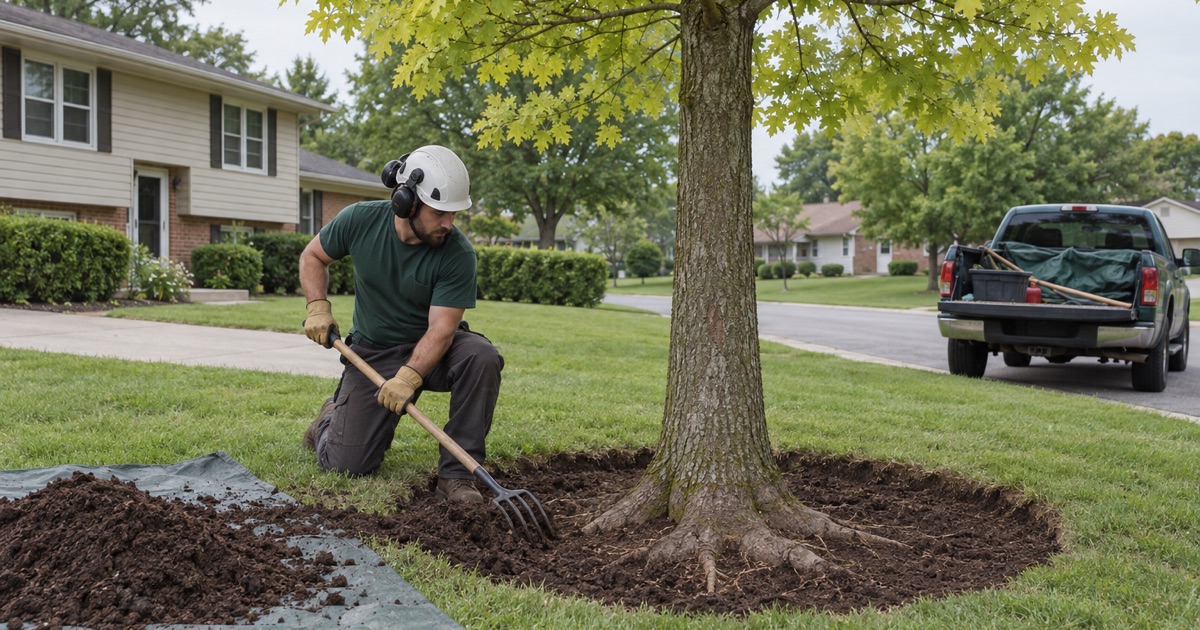
The most common cause of slow decline we find is mechanical and entirely fixable. Grade changes, settled planting beds and mulch mounded against a trunk bury the root flare, keeping bark that evolved to be dry permanently wet. Root collar excavation with an air spade removes that soil without cutting roots, exposes what is actually happening at the collar, and frequently ends a decline nobody had diagnosed in a decade.
Compaction, Soil and Deep Root Fertilization
Lawn soil under a mature canopy is usually compacted well past what fine roots can work in, and no amount of watering fixes that. Deep root fertilization places nutrients and amendments below the turf layer where the feeder roots are, radial trenching opens compacted ground along root paths, and a tree growth regulator can slow top growth so a stressed tree spends its budget rebuilding roots instead of leaves.
Species Doing What Their Species Does
Some decline is simply the calendar. K-State Research and Extension’s Johnson County guide names silver maple for weak wood, pin oak for soil issues, green ash for emerald ash borer, plus Austrian pine, Scotch pine, box elder, Bradford pear, Lombardy poplar, Siberian elm and willow among trees not recommended for the Kansas City area. A Bradford pear splitting at twelve years old is not sick, and there is no treatment for it.
What Treatment Involves, and Where Its Limits Are
Diagnosis Comes With a Document
A plant health visit ends with a written record naming the species, the diameter at breast height, what was observed at the collar, the trunk and the crown, and what we think is causing it. That matters when a treatment is going to run over several seasons, because the only way to know whether a program is working is to be able to compare it against a written baseline rather than a memory.
Cultural Correction Before Chemistry
Most of what actually improves a struggling tree in this market costs nothing chemical: uncover the flare, pull the mulch back off the bark, correct drainage, relieve compaction, and prune out the dead and broken wood to the ANSI A300 standard so the tree stops spending energy on it. Where a chemical program genuinely is the answer, it works far better on a tree whose cultural problems have been fixed first.
When the Answer Is Removal, and When It Is Urgent
Some findings end the conversation. University of Missouri Extension G6867 puts the line at whether at least half the crown is still intact, and says that past that point the tree has lost its survival edge; pine wilt carries its own deadline, and a dead ash carries a rising cost curve. In each of those cases we would rather quote the removal now than sell a program that postpones it at your expense.
- 20+ Years in the KC Metro
- Free On-Site Assessment
- Written Price, Insured Crews