Blue Springs Tree Removal runs crane-assisted tree removal across Blue Springs, MO, serving surrounding cities including Grain Valley, Independence, Oak Grove, Lee’s Summit and Raytown. A crane is not the default answer to a big tree. It is the answer to a tree whose weight has nowhere to go, which is a different problem and a much more common one on established lots than size alone would suggest.
Most removals are done from the tree, by a climber taking it apart in controlled pieces with a bull rope run through a Port-a-Wrap friction device, working inside a known working load limit under the ANSI Z133 safety standard. That method needs two things: a canopy sound enough to climb and rig from, and a drop zone underneath big enough to receive what comes down. Take either away and rigging alone stops being the safe option.
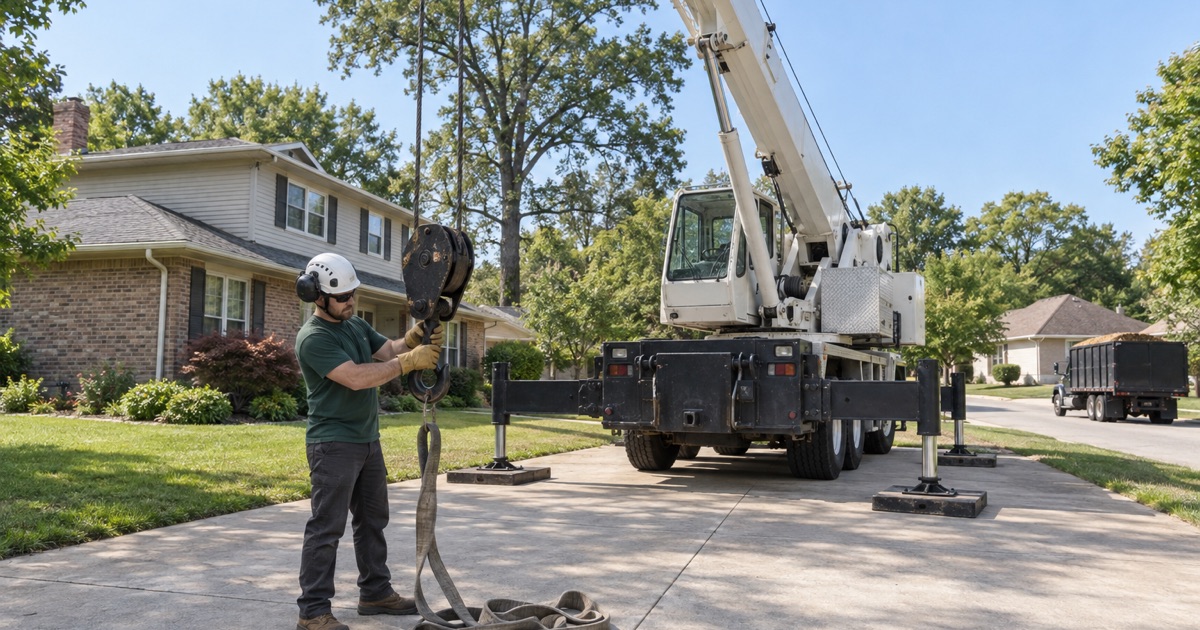
That is where a crane earns its cost. Each piece is picked before it is cut, carried out over whatever is in the way, and set down in the street or on a mat, so the load never passes over the roof, the pool, the deck or the neighbor’s fence at all. It also gets the crew out of a canopy that may not be worth trusting.
When a Crane Is the Right Answer
The Drop Zone Is Occupied
On a mature lot the ground under a tree is rarely empty. A pool, a patio, a sunroom, a septic field, a paved drive, an air conditioning unit or the neighbor’s garage roof all sit inside the arc a rigged limb would swing through. Where the pieces cannot be lowered without passing over something that would not survive a mistake, they get lifted out instead.
The Tree Cannot Be Safely Climbed
A canopy with heartwood decay, a lifting root plate, a split leader that has already moved, or the brittle hard wood of an ash killed by borer damage does not offer reliable tie-in points. Rigging depends on the tree holding loads it was never designed to hold, and a defective tree is exactly the one that will not. A crane replaces the tree as the load path entirely.
Storm Failures Under Tension
A trunk that has partly failed and is resting on a structure is holding energy, and cutting into it releases that energy in a direction that is difficult to predict. Picking the piece with a crane before the cut is made takes the guesswork out of it, which is why crane work and emergency work overlap so often after a wind event in this metro.
How a Crane Removal Runs
The Pick Is Planned Before Anything Is Cut
Each piece is assessed for weight and balance, the hook is set, the rigging is attached, and only then does the saw run. The climber or the operator in a lift makes the cut with the load already supported, so the piece never actually falls. Getting that sequence right is most of the skill, and it is why crane days run on a plan rather than on improvisation.
Setup, Outriggers and Ground Loading
The machine’s position determines everything else, because reach and capacity fall away together as the load moves out from the center. Outriggers concentrate a lot of weight into small footprints, so pads spread it, and drives, septic fields, retaining walls and soft ground all get considered before the truck is committed. Sometimes the right answer is to set up in the street.
Overhead Clearance and the Utility
Nothing swings near an energized conductor. Evergy publishes a minimum clearance of ten feet for conductors energized at 600 to 50,000 volts, or to the edge of the right-of-way where that is less, and the service drop from the pole to your meter is treated as the customer’s responsibility. Where a pick would cross either, the work gets coordinated with the utility rather than attempted around it.
Access, Cost and What Decides the Day
What We Look At on the Site Visit
Route in and out for a large truck, overhead clearance along that route, a legal and stable setup position, distance from setup to the trunk, what has to be flown over, where the pieces will be set down, and where the chipper and the log truck will stand. A crane job that is quoted without that walk is a crane job that will be renegotiated in your driveway.
Neighbors, Streets and Notice
Crane work is visible, noisy and briefly disruptive, and it frequently needs the space in front of somebody else’s house. We tell the neighbors ourselves rather than leaving you to. Where a city street has to be partly closed, that is arranged in advance through Public Works, and where a numbered state route is involved the right-of-way belongs to MoDOT rather than the city.
Why the Whole Job Is Often Cheaper
A crane compresses days into hours, reduces the number of rigging cycles to near zero, and removes almost all of the risk of a piece landing somewhere it should not. Set against a climbing crew on the same tree for two or three days, plus the standing possibility of a repaired roof or a replaced section of fence, the arithmetic tends to favor the crane far more often than customers expect.
- 20+ Years in the KC Metro
- Free On-Site Assessment
- Written Price, Insured Crews