Blue Springs Tree Removal handles property line and neighbor tree removal across Blue Springs, MO, serving surrounding cities including Grain Valley, Independence, Oak Grove, Lee’s Summit and Raytown. It is the job people put off longest, and rarely because of the tree. It is the conversation with the person on the other side of the fence, and the entirely reasonable worry that cutting the wrong branch turns a nuisance into a lawsuit.
Working a territory that crosses State Line Road makes that worry a two-part problem. Missouri and Kansas resolve encroaching branches under different legal rules, so the same fence, the same tree and the same complaint produce different starting positions depending on which side of the line the house sits. A crew that answers with one state’s rule everywhere will be confidently wrong roughly half the time.
We answer for the address. Before quoting a boundary job we establish which state’s rule applies, where the line actually runs rather than where the fence runs, and whether the tree’s condition changes the analysis, because it very often does. Then it goes in writing, because a boundary tree job that is not documented is a boundary tree job waiting to be argued about.
Two States, Two Rules for One Fence
Missouri Follows the Massachusetts Rule
In Hasapopoulos v. Murphy the Missouri Court of Appeals agreed with jurisdictions holding there is no cause of action for damage to neighboring property caused by the encroaching roots or branches of a healthy tree. The tree’s owner is not liable, and the complaining owner retains a right of self-protection by cutting off the offending roots or branches at the property line. Self-help, at your own cost, and no right to compel a healthy tree’s removal.
Kansas Reaches It Through Nuisance
On the Kansas side of this metro the same facts are analyzed as a possible nuisance under Pierce v. Casady rather than dismissed at the threshold. That is a materially different starting position for the same overhanging limb, and it is one reason a homeowner in Fairway or Leawood who calls a company that only works Missouri may get an answer that does not fit their situation at all.
Why the Difference Is Practical, Not Academic
This is the most common question a tree company gets asked, and it decides who pays. A homeowner told they simply have to live with it may spend years not solving a problem that is solvable, and a homeowner told they can do whatever they like may cut into treble damages. We start every boundary conversation by naming which side of the line the property is on.
What You May Cut, and What It Costs You
Self-Help Stops at the Boundary Plane
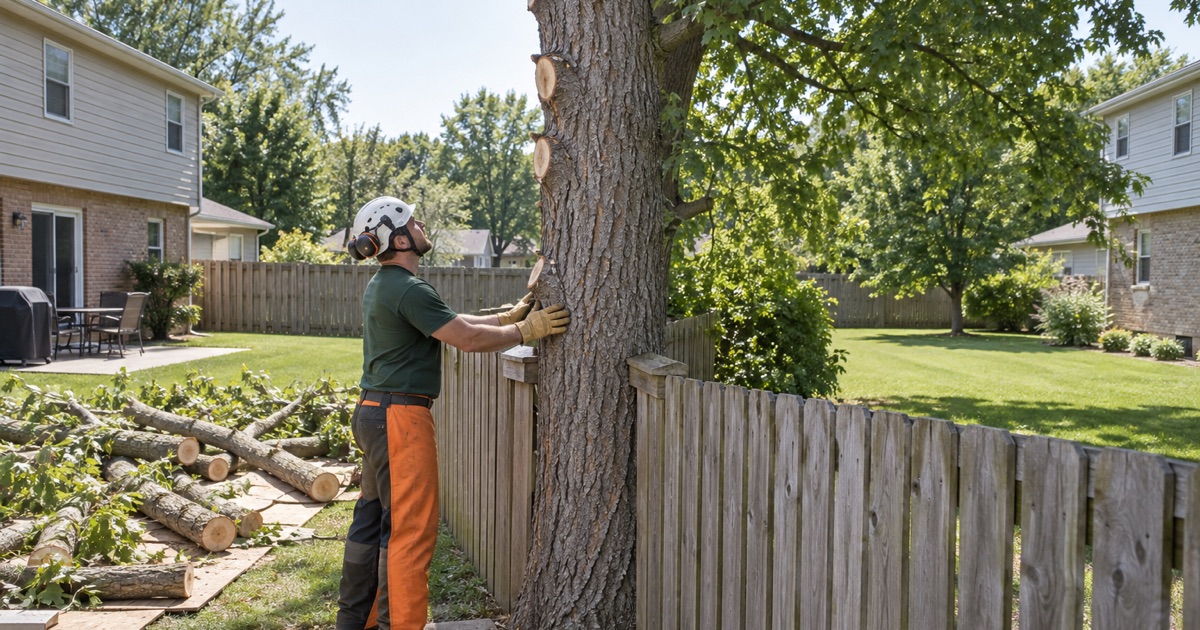
Cutting to the line means to the vertical plane above the line, and not one branch beyond it. It also means at your expense, and with the risk on you if the cut kills or destabilizes the tree. That is where RSMo 537.340.1 becomes live, since treble damages for injuring a tree grown for use, shade or ornament do not require proof of negligence or intent from the claimant.
Cutting to the Line Is Rarely Good for the Tree
A tree pruned hard on one side only loses canopy asymmetrically, sheds interior wood on the shaded side, and often responds with epicormic sprouts along the cut faces. Where a large limb has to come off to clear a line, we would rather propose a reduction that keeps the tree balanced and takes the encroachment down at the same time, and explain that option to both owners before anything is cut.
When Condition Changes the Answer
A Decayed Tree Is a Different Legal Question
The healthy-tree rule does not protect an owner who keeps a tree in a damaged, decayed or diseased state. Conks at the base, heartwood decay behind an old wound, a lifting root plate and a union splitting on included bark are the observable evidence, and once they are recorded and dated the owner is choosing a known risk. That is the point at which a neighbor’s request stops being a preference.
The Report Is the Instrument, Not the Argument
What moves a reluctant neighbor, an association board or an insurer is a document: species, diameter at breast height, defects observed, what sits inside the potential drop zone, and a recommendation with a timeframe. Missouri’s insurance regulator has itself noted that a tree already dead or diseased complicates the negligence question, so the dated record cuts in both directions and is worth having whichever side of the fence you are on.
Boundaries, Surveys and Getting It in Writing
The Fence Is Not the Line
Fences get rebuilt where the old one stood, hedges creep, and Osage orange rows planted as living fence a century ago sit wherever they were planted. None of that is evidence of a boundary. Where the line matters to the job and the physical markers disagree, we recommend a survey before we quote, because a survey is cheaper than a treble damages claim by a wide margin.
Trees Whose Trunks Straddle the Line
A trunk standing on the boundary is the one case where we will not act on one owner’s instruction alone. We will inspect it, document it and give both households the same written assessment, and if the two of them agree on the work we will do it. What we will not do is let one neighbor use our truck to settle something the other has not agreed to.
Written Scope, Insured Crew, Named Debris Routing
Every boundary job we take leaves with a written scope naming exactly which limbs come off and where the cuts land, proof of insurance sent before the crew is scheduled, and a stated destination for the wood and brush. On a job where two households are watching, being able to point at the page and say this is what we agreed is worth more than any amount of goodwill.
- 20+ Years in the KC Metro
- Free On-Site Assessment
- Written Price, Insured Crews