
Blue Springs Tree Removal handles shrub, hedge and brush removal across Blue Springs, MO, serving surrounding cities including Grain Valley, Independence, Oak Grove, Lee’s Summit and Raytown. This is the work that never quite fits a normal yard service: too much material for a mower crew, too little for a land clearing outfit, and far too much for anything the curb will accept.
The curb is the part worth understanding before you get a quote. Blue Springs operates no curbside brush collection, and what the city does publish is a set-out limit built for a homeowner pruning a shrub, not for a bed being cleared. Once the material is past that limit, somebody has to haul it, and hauling it costs money at the gate under Missouri’s own disposal law.
So our brush quotes name two things: what is coming out, and where it is going. A cheap brush price that ends with a pile beside your driveway is not cheap, it is unfinished, and the neighbors will notice before the hauler does.
What Brush Work Actually Covers
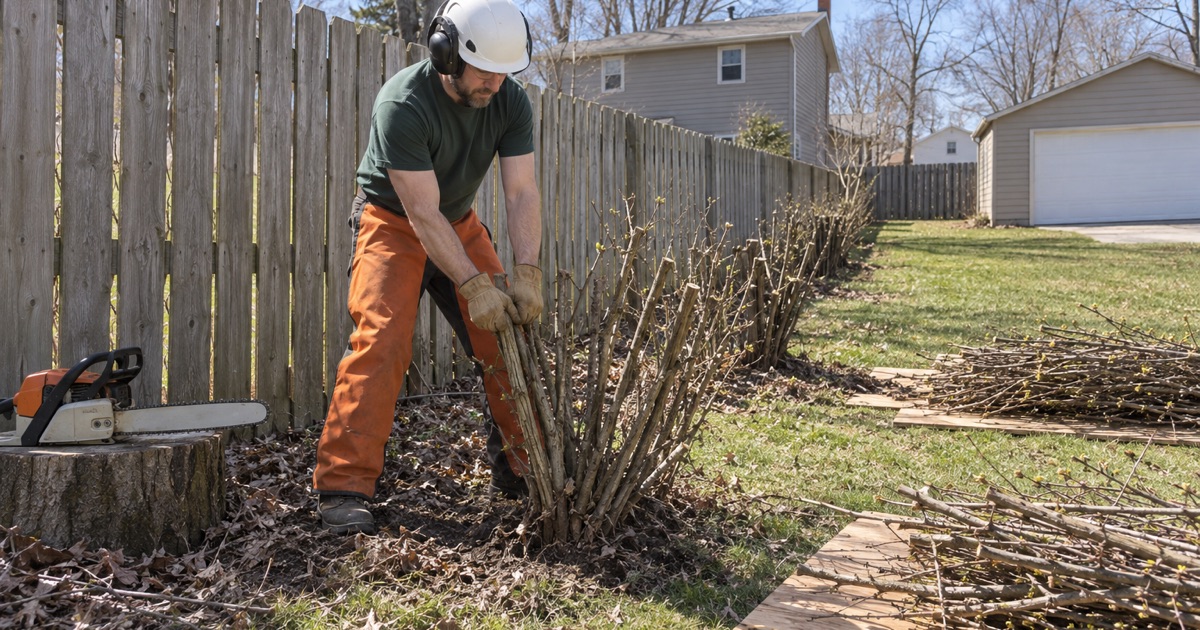
Overgrown Foundation Beds and Ornamental Shrubs
Yews, junipers, burning bush, boxwood and privet planted with a house thirty or forty years ago outgrow the bed and then outgrow the window. Shearing them again buys a season; taking them out and grubbing the root balls gives the bed back. We remove the crown and root mass rather than cutting at grade, because a sheared stump of most ornamental shrubs simply resprouts into the same problem.
Hedges, Screens and Property-Line Rows
A hedge that has become a wall of trunks is no longer a hedge, and rejuvenation pruning past a certain point stops working. Removing and replanting is often cheaper over five years than continuing to fight it. Where a hedge row sits on or near a boundary we check the line before quoting, because a row planted as a screen decades ago is frequently not where either owner assumes it is.
Storm Brush and Post-Removal Cleanup
After a wind event, or after somebody else took a tree down and left the small material, brush work is volume work: gathering, chipping and hauling what is already on the ground. It is quoted by what has to leave rather than by what has to be cut, which is usually a far better deal for the customer than a per-item price would be.
The Curb Will Not Take It
What Blue Springs Actually Allows
The city’s own rule caps curbside limbs at less than four inches in diameter, requires brush and limbs to be securely tied in bundles no larger than forty-eight inches long and eighteen inches across, and puts a seventy-five pound ceiling on any individual bundle. Trash and yard waste here are private subscription rather than a city service, and yard waste is generally an at-additional-cost option on those contracts.
Where the City Sends Residents Instead
Blue Springs runs no brush yard of its own. Its residential disposal guidance routes people outward, to the Jackson County center at 816-847-7050, to Missouri Organic Recycling at 816-483-0908 and to the Lee’s Summit Resource Recovery Park. That is a workable answer for a car boot full of clippings and an impractical one for a cleared bed, which is the gap this service fills.
The Gate Charges by Volume
Under RSMo 260.250, yard waste has been barred from Missouri solid waste disposal areas since 1992, which is why every outlet for this material in the metro is a composter. Missouri Organic Recycling publishes two dollars per bag, ten dollars per cubic yard of brush and seven dollars per cubic yard of lawn debris. Brush is bulky, so on a big clearance that line is genuinely significant and we would rather show it than bury it.
Invasive and Volunteer Growth Around Homes
Bush Honeysuckle in Residential Fence Lines
Bush honeysuckle does not stay on acreage. It colonizes the back fence line of ordinary subdivision lots, holds the ground by leafing out first and dropping leaves last, and shades out everything planted underneath it. Cutting alone regrows from the stump, so removal means cutting and treating the cut surface, then a follow-up visit for the seedlings the seed bank produces.
Callery Pear and Volunteer Trees in Beds
Callery pear seedlings, mulberry, elm and hackberry volunteers come up through beds, along fences and behind sheds, and by the time they are noticed they have a root system worth removing properly. Missouri’s own legislation on Callery pear works through a nursery registration condition reaching sales on or after January 1, 2029, so nothing restricts taking one out of your own yard today.
Poison Ivy, Vines and What Grows Up the Trunk
Vines climbing a mature tree are the growth people most often ask us to leave and most often should not. Heavy vine load adds wind sail and weight to a canopy, hides the trunk defects an inspection needs to see, and in the case of poison ivy makes every subsequent piece of work on that tree harder and more expensive. Taking it off is cheap now and awkward later.
- 20+ Years in the KC Metro
- Free On-Site Assessment
- Written Price, Insured Crews