
Blue Springs Tree Removal has been doing stump grinding across Blue Springs, MO for more than twenty years, serving surrounding cities including Grain Valley, Independence, Oak Grove, Lee’s Summit and Raytown. It is the part of a removal most people forget to ask about until the tree is gone and a knee-high disc of hardwood is sitting in the middle of the lawn. We quote it with the removal, or on its own for a stump somebody else left behind.
Two things decide what a stump job costs here, and neither of them is the diameter alone. The first is what has to happen underground before a machine can start, because Missouri law requires a locate request through Missouri 811 at least three and not more than ten working days before any excavation, and a stump grinder is excavation. The second is what you want done with the pile afterward.
We answer both in writing before we start. That includes the depth we expect to reach on your particular stump, what we will do with the grindings, and whether the spot is being handed back raked level or filled and ready for seed. A quote that leaves the grindings out is a quote that is going to grow.
Grinding, Excavation and Which One Your Lot Needs
How a Stump Grinder Actually Works
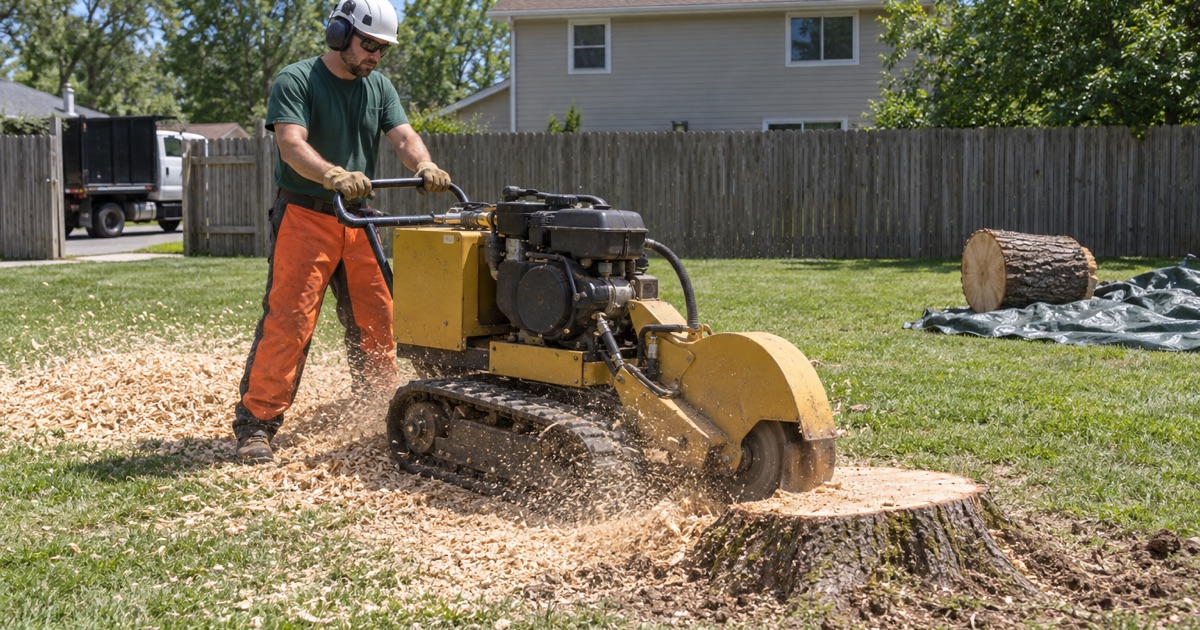
A stump grinder tooth wheel spins carbide teeth across the face of the stump and takes it down in passes, sweeping side to side and advancing as the wood gives way. It does not pull anything out of the ground; it converts the stump and its buttress roots into a mound of chips in place. That is why the finished result is a cavity rather than a crater, and why the surrounding lawn, drive and irrigation usually survive the process intact.
Below-Grade Cut Depth, and Why It Is a Per-Lot Answer
Machines in this class are rated for a below-grade cut depth in the range of twelve to twenty-five inches. The ground here is not usually the constraint: the Sibley series, a deep loess-derived silt loam whose USDA type location is in Jackson County, carries a solum typically fifty to sixty inches deep, so there is no shallow-rock story on most of this territory. What stops a grinder is buried irrigation, old landscape stone, a gas or fiber line the locate flagged, or simply a stump wedged tight against a foundation.
When Excavation Is the Right Call Instead
If a footing, a slab, a retaining wall or a utility trench is going where the tree was, grinding is the wrong tool, because everything below the grind is still there. Excavating the root plate whole leaves a large hole and a pile of soil, but it hands the next trade clean ground. On a finished lawn that trade-off almost never pays; on a building lot it almost always does.
The Grindings, the Hole and What You Get Back
Raked Level, or Hauled Out
Grindings mound noticeably higher than the stump they replaced, because wood chips take up more room than solid wood did. Raked level and crowned, they settle over a season and turn into a soft, slightly sunken patch. Hauled out and backfilled with clean soil, the spot is ready for seed or sod immediately. We price both ways and let you pick, rather than assuming the cheap one.
Why Grass Struggles in Fresh Grindings
Decomposing wood chips pull nitrogen out of the soil around them while they break down, so seed sown straight into a grinding pile comes up thin and yellow while the lawn beside it is fine. Mushrooms fruiting on the spot for a year or two are the same process seen from above. If sod or seed is the plan, taking the grindings away and replacing them with topsoil is the difference between a repair and a scar.
Where the Material Goes When It Leaves
Under RSMo 260.250 yard waste has been barred from Missouri disposal areas since 1992, so nothing organic goes to a landfill here. Grindings and removal wood go to a composting gate, and Missouri Organic Recycling, which runs the commercial gates in this market, publishes rates of ten dollars per cubic yard of brush and seven dollars per cubic yard of lawn debris. It also refuses stumps with dirt on them, which is exactly why grinding is the disposal-friendly option.
Access, Utilities and the Things That Change the Price
Gate Width and Ground Conditions
The first measurement we take on a back-yard stump is the narrowest point on the route to it. Compact machines fit a standard side gate; larger units need a wider opening, firm ground and a route that does not cross a septic field or a soft new lawn. Where nothing fits, the honest answer is sometimes to cut the stump flush and treat it rather than to promise access we cannot get.
Utilities, Irrigation and the 811 Locate
The public locate marks gas, electric, water and communications in the right-of-way and up to the meter, but it does not mark your irrigation, your low-voltage lighting, your invisible fence or the conduit somebody ran to a shed. Tell us where those are before we start. A grinder finds them instantly and expensively, and they are the one category of buried line no locate service is going to flag for you.
Multiple Stumps and Old Fence Lines
Stumps are cheaper in quantity because most of the cost is getting the machine there. A row of old hedge stumps along a fence line, a cleared bed full of shrub crowns, or three trees taken out in the same season are all worth doing on one visit. Where the row sits on a boundary we check the line first, because a stump on the wrong side of it is a neighbor’s tree with the same legal weight a standing one would have.
Our Step-by-Step Stump Grinding Process
Step 1: Measure, Look and Quote in Writing
We measure the stump at grade, check the route and the gate, look for surface roots that have to come out with it, and ask what is going back into the space. The quote names the expected depth, the grindings decision and the disposal routing, so nothing about the finished result is a surprise.
Step 2: File the Locate and Wait Out the Notice
The locate request goes to Missouri 811 and the state’s own window is at least three and not more than ten working days before work begins. We schedule around it rather than through it. If a stump has to be gone by a date, that window is the thing to plan backward from.
Step 3: Grind, Then Clear the Surface Roots
The stump comes down in passes to the agreed depth, and the buttress roots radiating from it are ground back far enough that nothing surfaces through a new lawn. On a stump beside a walk or a drive we work the edge carefully rather than fast, because concrete is easier to chip than to replace.
Step 4: Backfill, Level and Clean Up
Grindings are either raked into the cavity and crowned for settling or loaded out and the hole filled with clean soil. Either way the surrounding turf gets blown clear and the chips get off the hard surfaces before we leave, because a stump job that ends with wood chips in the driveway joints is not finished.
- 20+ Years in the KC Metro
- Free On-Site Assessment
- Written Price, Insured Crews