
Blue Springs Tree Removal has been doing land clearing and lot clearing in Blue Springs, MO for more than twenty years, serving surrounding cities including Grain Valley, Independence, Oak Grove, Lee’s Summit and Raytown. Clearing is measured in acres and hours rather than in trees, and the thing that decides the price is almost never the biggest trunk on the site. It is what has to leave, and how far it has to go.
That is a bigger variable in this market than most people expect. Missouri has kept yard waste out of its disposal areas since 1992 under RSMo 260.250, so every outlet for cleared material here is a composting operation charging by the cubic yard rather than a landfill charging by the ton. On a wooded half acre that routing decision can be a larger line than the cutting.
So we walk the site, agree what the ground has to look like when we are finished, and quote the two halves separately: the clearing itself, and the fate of the material. Mulched in place, chipped and hauled, or stacked for the owner are three different prices, and picking one before the machines arrive is how a clearing job stays on its number.
What Clearing Actually Involves Here
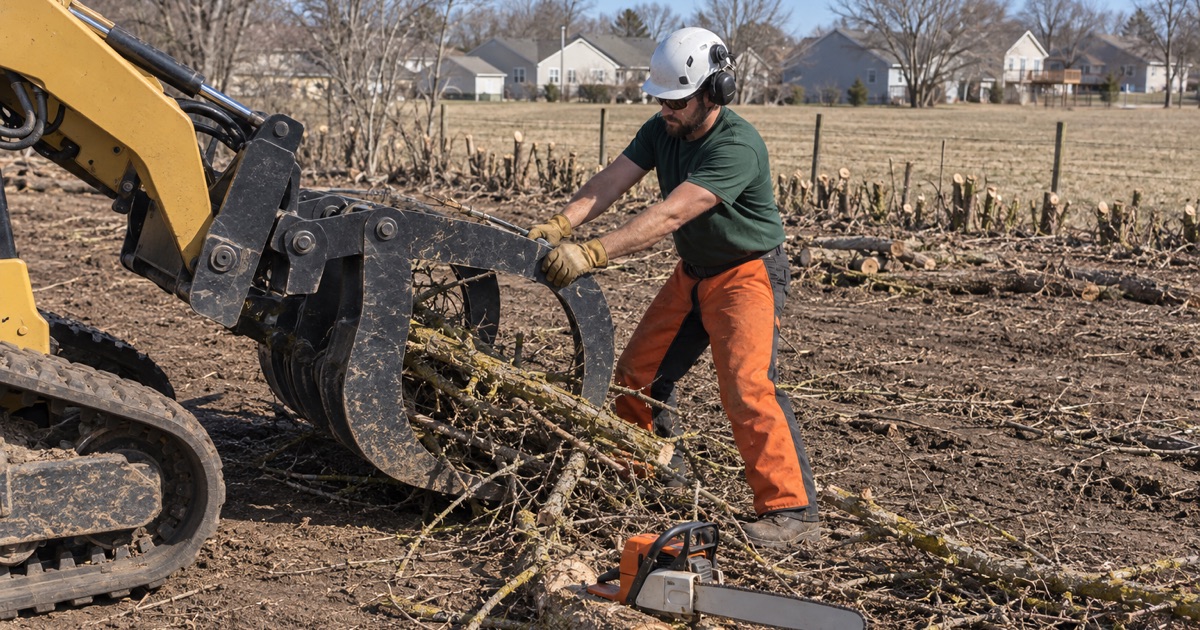
Define the Finished Grade Before Anything Runs
The single most useful question on a clearing job is what is going on the ground afterward. Pasture, a food plot, a trail, a fence line, a lawn, a driveway and a building pad each imply a different depth of work, and a site cleared to lawn standard is not a site ready for a footing. We set that target in writing first, because clearing to the wrong standard is expensive to discover later.
Access, Terrain and Wet Ground
Equipment has to reach the work and leave without turning the approach into ruts. Slope, soft ground after rain, a single narrow entry, an existing drive that cannot take tracked weight and a creek crossing are all things that change the machine we bring and sometimes the season we do it in. We would rather move a job by two weeks than repair an approach we destroyed getting to it.
Utilities, Easements and What Is Buried
Before anything digs or grinds, a locate request goes to Missouri 811, and state law under RSMo Chapter 319 requires that at least three and not more than ten working days before work begins. Public utilities get marked; private irrigation, low-voltage lighting, invisible fence and shed feeds do not, so we ask the owner for those. Utility easements crossing the site also change what may be removed and by whom.
Forestry Mulching Versus Conventional Clearing
What the Mulching Head Does Well
Forestry mulching grinds standing brush and small stems into a mulch layer in place. Nothing is hauled, so the disposal line disappears entirely; the mulch left behind holds soil against erosion and suppresses regrowth for a season. On overgrown acreage, fence lines and trail corridors it is usually both the cheapest and the least destructive option available.
Where Mulching Is the Wrong Tool
A mulching head has a stem-size limit, and pushing past it is slow, hard on the machine and produces a poor result. It also leaves organic material on the surface and stumps in the ground, which is exactly what a builder does not want under a slab, a road base or a utility trench. Where the plan calls for clean subgrade, conventional clearing and root plate excavation is the correct answer.
Mixed Approaches on One Site
Most real sites are not one or the other. A typical acreage job might mulch the brush understory, take the merchantable and hazardous stems down conventionally with rigging where they lean toward a structure, grind the stumps in the area that is becoming lawn, and excavate the plates only where the barn is going. Splitting the site by finished use is how the budget lands where the value is.
Invasive Brush, Hedge Rows and Old Fence Lines
Bush Honeysuckle Is the Volume Job
Bush honeysuckle holds a wood edge or a fence line by leafing out before everything else and dropping leaves after it, shading out whatever is underneath. Cutting it alone regrows from the stump, so removal means cutting and treating the cut surface promptly, then returning for what the seed bank produces. It is quoted by the area cleared rather than by the stem, and the second visit is part of the job rather than an upsell.
Osage Orange and the Old Living Fences
Osage orange, the hedge tree, was planted as living fence across this part of Missouri and Kansas long before wire was cheap, and those rows are still standing behind newer subdivisions and along field edges. The wood is dense and thorny, the stems are usually multi-trunked from a century of cutting, and the row very often marks a legal boundary. We check ownership before we quote one.
Callery Pear and Volunteer Regrowth
Callery pear escapes into fence lines and field margins and comes back hard from a cut stump, which puts it in the same operational category as honeysuckle rather than in the tree category. Missouri’s own legislation on it works through a nursery registration condition reaching sales on or after January 1, 2029, so nothing about removing one from your own land is restricted today. Removing it properly means treating the stump, not just cutting it.
Our Step-by-Step Land Clearing Process
Step 1: Walk the Site and Agree the Target
We walk the ground with the owner or the builder, mark what stays, identify boundaries and easements, and write down what the finished surface has to be. Trees worth keeping get flagged and their root zones get a protection line, because a preserved tree killed by construction traffic is a loss nobody budgeted for.
Step 2: Locate, Permit Check and Sequence
The Missouri 811 locate goes in and the notice period runs. Where the work is tied to development we confirm what the Unified Development Code requires of the site before anything is felled, since tree preservation here is a development requirement rather than a removal permit. Then the work is sequenced so equipment is not driving across ground it has already finished.
Step 3: Fell, Mulch and Separate the Material
Stems come down under control, rigged where anything below them matters. Material is separated as it is produced: mulched in place where that is the plan, chipped for haul where it is not, and trunk wood set aside if the owner wants it. Sorting once at the machine is far cheaper than sorting twice at the pile.
Step 4: Stumps, Cleanup and the Handover
Stumps are ground or excavated according to what the finished use needs, the site is raked out to the agreed standard, and the haul-off leaves for a composting gate with the volume recorded. We walk the finished ground with you before the equipment goes on the trailer, because the time to say the corner by the shed is not right is while the machine is still there.
- 20+ Years in the KC Metro
- Free On-Site Assessment
- Written Price, Insured Crews