Blue Springs Tree Removal has worked as the arborist on hazard trees across Blue Springs, MO for more than twenty years, serving surrounding cities including Grain Valley, Independence, Oak Grove, Lee’s Summit and Raytown. Arborist work here is the diagnostic half of the trade: looking at a tree, deciding what is actually wrong with it, and writing down the answer in a form somebody else can act on. It is the part of this business that most often ends with advice not to remove anything.
That matters more in this market than a certificate would, because neither Missouri nor Kansas licenses tree work. There is no state exam and no state card, which means the only way to tell a competent inspection from a confident opinion is to read what the inspector wrote. We put ours in writing every time, with the species, the diameter at breast height, the defects we found and the reasoning that connects them to the recommendation.
The other reason to have it on paper is that tree arguments in this metro are rarely between one person and a tree. They are between a homeowner and a neighbor, an association, an insurer, a buyer or a city, and each of those responds to a dated document differently than to a phone call. We write assessments expecting them to be handed to somebody else.
What a Tree Risk Assessment Examines
The Defects That Predict Failure
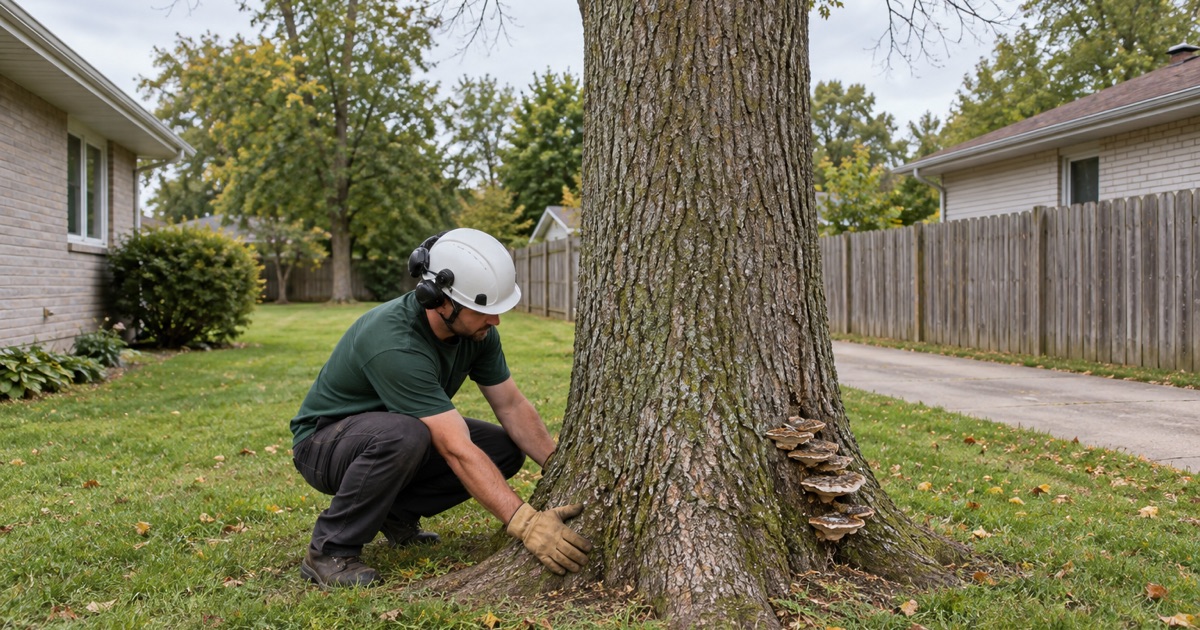
We work down the tree from the crown to the root plate: dead and hanging wood, weak or over-extended branches, cankers, conks pushing out of the bark, heartwood decay behind an old wound, severe lean, and root failure showing as a plate lifting on one side. Evergy’s own vegetation inspectors publish that same symptom list, which is a useful outside confirmation that these are the things worth looking at.
Structure, Unions and Co-Dominant Stems
The defect that removes the most trees in subdivision-age yards is not decay but architecture. Two leaders of similar diameter meeting at a tight union trap bark inside the joint, and that included bark never knits, so a co-dominant stem holds until a loaded wind event finds it. A split leader that has already moved is a different conversation from one that has not, and telling them apart is the whole value of the inspection.
Targets, and Why They Change the Answer
Risk is not a property of the tree alone. The same leaning silver maple is a monitoring job over an empty back fence line and an urgent one over a bedroom or a driveway where cars park, so we record what sits inside the potential drop zone and how often anybody is in it. Two identical trees on two identical lots can honestly earn two different recommendations.
The Report, and What Goes In It
Species, DBH and the Measurements That Anchor It
Every assessment records the species and the diameter at breast height, because those two facts set the scale for everything else and because a later reader needs to know the report describes the tree still standing in the yard. Diameter also connects to local code: the Blue Springs Unified Development Code awards tree credit units by diameter at four and a half feet on development sites, so the measurement is the same one the city uses.
A Recommendation That Can Be Acted On
A finding without an instruction is not much use. Our reports say remove, prune, cable, monitor on a stated interval, or investigate further with root collar excavation, and each of those comes with what it would involve. Where the recommendation is to keep the tree, that is stated as plainly as a removal would be, because a report that only ever recommends the writer’s most expensive service is not an assessment.
Written for a Third Party to Read
Assessments get forwarded. An association board, an adjuster, a title company or a neighbor’s attorney will read the document without ever meeting the tree, so it avoids jargon it does not need, spells out the standard behind any threshold, and dates itself clearly. Where a claim rests on a published source, we name the source rather than asserting the number ourselves.
When a Report Settles Something
Boundary and Neighbor Disputes
Missouri follows the Massachusetts Rule, so a healthy tree overhanging a fence gives the neighbor no cause of action and only a right to cut back to the line at their own cost. Condition changes that, since liability attaches where an owner maintains a tree in a damaged, decayed or diseased state. A dated assessment is what converts an argument about opinions into a record of what was known and when.
Insurance and Duty of Care
Missouri’s insurance regulator has published that homeowners coverage contributes to removing a tree that damages the home or other insured property, and that a tree already dead or diseased complicates the negligence question. That is the practical case for inspecting before a storm rather than after one: the same defect documented in advance reads as diligence, and undocumented reads as neglect.
Associations, Landlords and Commercial Property
A board or a property manager cannot act on a verbal warning without something to show the owners, and a landlord with several addresses needs the trees ranked rather than described. We inventory by address, note the defects on each tree, and give a priority order, so a maintenance budget can be spent on the three trees that matter this year instead of spread evenly across thirty that do not.
Our Step-by-Step Assessment Process
Step 1: The Free On-Site Look
The first visit costs nothing and establishes whether a formal report is warranted at all. Many trees do not need one: an obviously dead ash or a pine with pine wilt is a removal decision, not a research question, and we will say so on the spot rather than selling a document to reach an answer that is already visible.
Step 2: Ground and Aerial Inspection
Where a report is warranted, we inspect the root collar, sound the trunk, and where the crown cannot be judged from the ground we climb it under the ANSI Z133 safety standard. Buried root flares are common in landscaped beds and often hide the decay that decides the case, which is when we recommend pneumatic soil excavation with an air spade before concluding anything.
Step 3: The Written Assessment
Findings, measurements, targets, recommendation and timeframe go into one document, and you receive it whether or not you hire us for the work that follows. Where a published standard supports a threshold, it is named in the text, so a reader can check it instead of taking our word for it.
Step 4: Pricing the Recommended Work, Separately
If the recommendation is work, we quote it as its own written price with the disposal routing named, and you are free to take that document to anybody else. Keeping the assessment and the bid separate is deliberate. An inspection that only pays when it finds a removal is not an inspection.
- 20+ Years in the KC Metro
- Free On-Site Assessment
- Written Price, Insured Crews