
Blue Springs Tree Removal has been running emergency tree removal in Blue Springs, MO for more than twenty years, serving surrounding cities including Grain Valley, Independence, Oak Grove, Lee’s Summit and Raytown. Emergency work is a different trade from scheduled removal: the tree has already done what it was going to do, and the job is to stop it doing anything else while somebody else’s claim is still being written.
So the first visit is a make-safe visit. We tarp openings, relieve load off a compromised structure, cut what is going to move next, and photograph the whole thing before it changes. Only then do we quote the removal, because a price given before the roof has been seen is a price that gets revised, and a revision after a storm reads as an opportunistic one whether it is or not.
The other half of emergency work is telling you which phone to pick up. A tree on the house, a tree on the car, a limb on a service drop and a trunk across a public street are four different jobs with four different owners, and getting that order wrong costs hours. We answer that question on the first call, before we quote anything.
The First Hour
People, Then Structure, Then the Tree
Everybody out of the rooms under the impact, and out of the yard on the side the tree leans toward, because a partially failed tree is still failing. Water and electricity get shut off to affected areas if the structure is compromised. Nothing about the tree changes in the next twenty minutes, and the decisions that go wrong in an emergency are almost always made by somebody standing in the wrong place.
Photograph It Before Anyone Improves It
Adjusters reconstruct events from what they are shown. Wide shots from several angles, the point of failure, the damage inside, and anything the tree hit on the way down are worth five minutes each and are impossible to recreate once a crew has cut a path in. We photograph our own sequence too, so the record shows the state we found and the state we left.
The Call Order, Written Down
A downed conductor is 911 first, then Evergy at 888-544-4852, and nobody within thirty feet in the meantime. A blocked city street is the Blue Springs Streets Division at (816) 228-0195 in working hours and the police non-emergency line outside them. A numbered state route is MoDOT at 1-888-ASK-MoDOT. A damaged structure is your homeowners carrier, and a damaged vehicle is your auto carrier.
Storm Damage and What Actually Happened
Wind Events in This Metro Have Names Worth Using
The National Weather Service office at Pleasant Hill, which forecasts for this area, titles the damaging events here wind storms, squall lines and downbursts, and its own event list includes the July 14, 2023 wind storm that produced widespread power outages across Kansas City. Naming what hit you correctly matters when a claim is filed, because the carrier is reading the same public record.
Ice Loading Is a Different Failure
The February 5 to 7, 2019 ice storm brought an eighth to a quarter inch of accretion across eastern Kansas and central Missouri. Ice bends and sheds limbs rather than snapping trunks, and much of what looks catastrophic under load recovers once the load is gone. The trees that do not recover are the ones that were already carrying a defect, which is the argument for having them looked at before a season rather than after one.
Which Trees Fail, and Why It Is Predictable
The failures we cut out of yards here are concentrated on a short list of species and one recurring defect. K-State Research and Extension’s Johnson County guide instructs against planting the Bradford cultivar because severe splitting occurs on trees ten to fifteen years old, and names silver maple for weak wood among others not recommended for this area. Add a co-dominant union with included bark and you have most of the storm work in this metro.
Insurance, Costs and Who Pays for What
What Homeowners Coverage Actually Reaches
Missouri’s insurance regulator has published that homeowners coverage contributes to removing a tree that damages your home or other insured property, and that some companies limit the amount available for tree removal, giving five hundred dollars as an example figure. It does not say whether such a limit runs per event or per tree, and neither will we. A tree that comes down and hits nothing insured is usually a cost the owner carries.
The Neighbor’s Tree That Landed on You
The same guidance is unusually clear here: removal of a neighbor’s fallen tree from your property is covered regardless of who owned it, and where your tree damages a neighbor’s property, in most circumstances the neighbor claims under their own policy. What changes that calculation is condition, because a tree that was already dead or diseased complicates the negligence question, which is why a dated assessment before a storm is worth more than an argument after one.
How a Make-Safe Visit Is Priced
The emergency visit is its own line, because it is its own job: crew, travel, stabilization, tarping, load relief and documentation, quoted for what it is rather than folded into a removal nobody has scoped yet. The full removal follows as a separate written price once the structure has been assessed. Splitting them keeps the quote readable for an adjuster and keeps you from paying storm rates for routine work.
Our Step-by-Step Emergency Response
Step 1: Triage on the Phone
We ask what the tree is touching, whether anyone is in the building, and whether any wire is involved, because those three answers decide whether you should be calling us at all yet. If a conductor is down, we tell you to hang up and call 911 and Evergy first, and we do not roll a crew into a hot site.
Step 2: Secure the Site
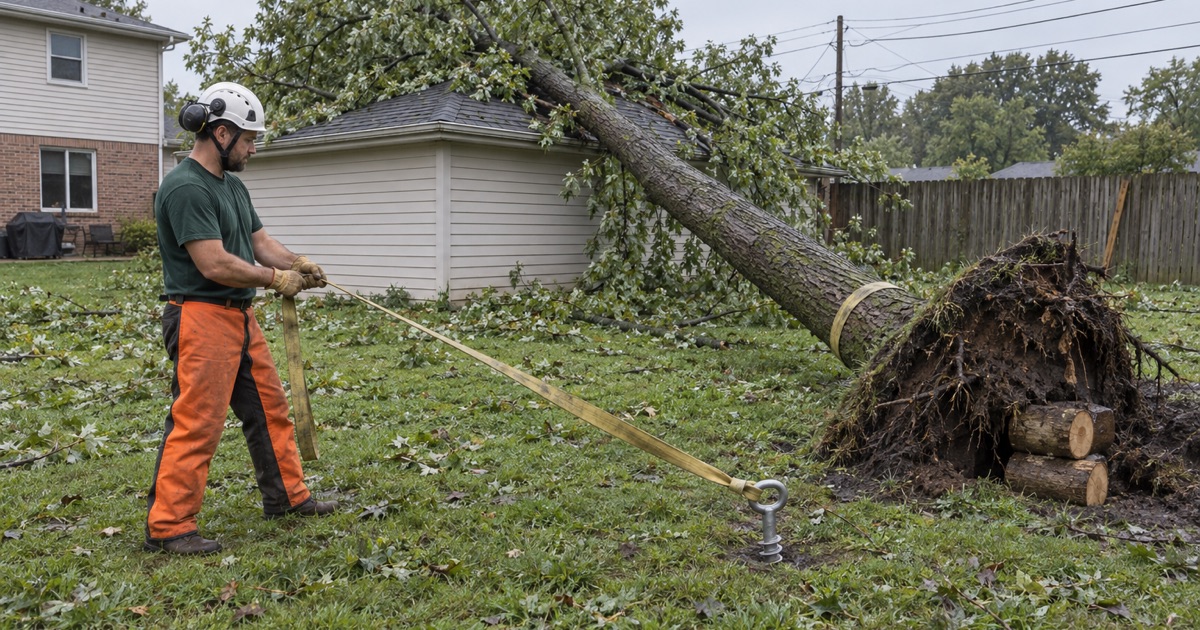
On arrival the hazard perimeter goes up first and stays up. Compromised limbs still hanging, a partially uprooted trunk with a lifting root plate, and anything under tension get dealt with before general cleanup starts, because the second failure in a storm sequence is the one that hurts somebody.
Step 3: Make Safe and Document
Tarps over openings, load relieved off the structure, the vehicle freed, the driveway or exit opened. Photographs at each stage. Where the tree is going to be removed in a later visit, we leave it in a state that will not change overnight rather than in a state that merely looks tidier.
Step 4: Remove, Clear and Route the Debris
The removal itself is rigged rather than dropped where a damaged structure is in the way, using a bull rope and friction control, and a crane where the load will not come down any other way. The wood and brush leave with us to a composting gate, because RSMo 260.250 has kept yard waste out of Missouri disposal areas since 1992 and nothing is being stacked at your curb after a storm the whole street is cleaning up from.
- 20+ Years in the KC Metro
- Free On-Site Assessment
- Written Price, Insured Crews