Tree Removal in Blue Springs, MO

More than twenty years of removals, storm work, pruning and stump grinding across both sides of the Kansas City state line.

Blue Springs Tree Removal has spent more than twenty years taking trees down across Blue Springs, Missouri and the wider Kansas City metro: emergency and storm work, full removals, trimming and pruning, stump grinding, land and lot clearing, brush and hedge work, crane-assisted takedowns, tree disease treatment, and the arborist reports that settle a risk argument on paper. Every one of those jobs opens the same way, with a free on-site assessment and a written price. What you are quoted is what you pay, and the assessment behind it is a document you keep.

We work both sides of the state line, and that is not a coverage boast. Missouri and Kansas resolve a neighbor’s overhanging tree under two different rules, so a crew that only knows one of them will give you a confident wrong answer twenty minutes down the road. Proof of insurance reaches you before anybody sets foot on the property, and the written condition assessment reaches you before the saw comes out of the truck.

We also tell you what we will not do. We do not top trees, and if a tree can be held together with cabling and bracing or corrected with structural pruning, we say so and price that instead of a removal. Before we start you will know where the wood and the brush are going, because in this market that is a routing decision with a real cost attached, and nothing is stacked at your curb for a hauler to refuse.

Get Your Free Quote

Fast response • No obligation

So we can reach you about your request.

So we can send you a confirmation after you submit this inquiry form.

  • 20+ Years in the KC Metro
  • Free On-Site Assessment
  • Written Price, Insured Crews

What we do

Our Services

Tree removal and arborist work in Blue Springs, Missouri

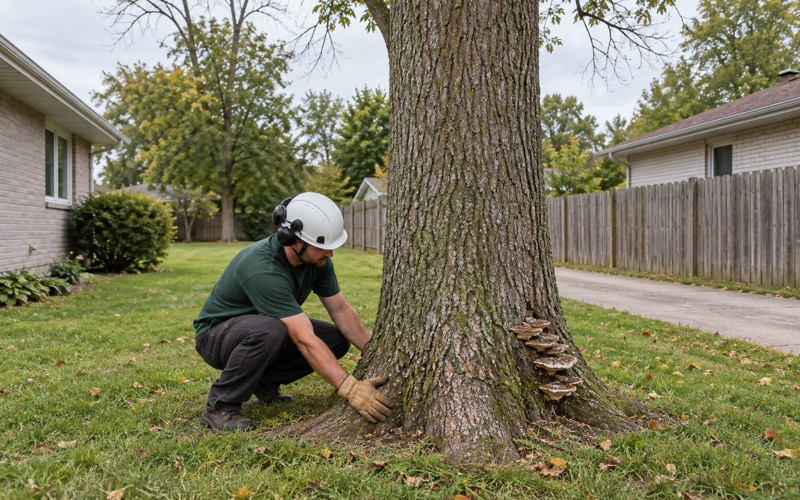
Worker reading a bracket fungus at the root flare of a declining green ash on a Blue Springs lawn.

Arborist

Tree risk assessment and written arborist reports for homeowners, associations and insurers across Blue Springs and the Kansas City metro.

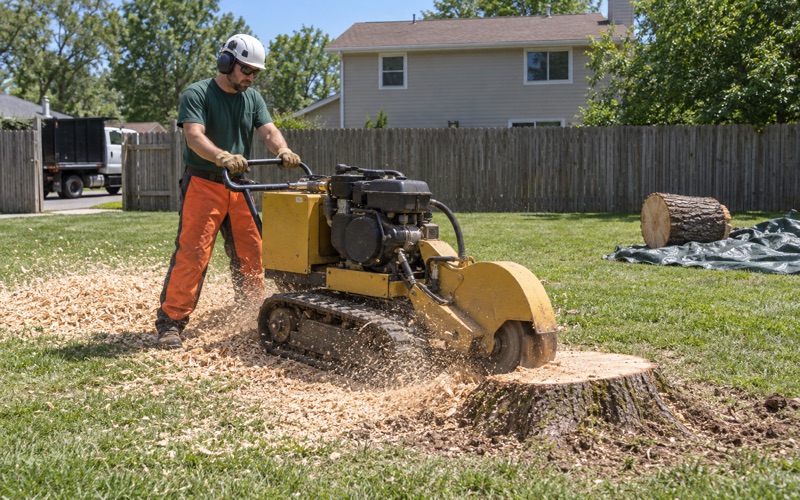
Worker sweeping the grinder wheel across a silver maple stump face on a Blue Springs lawn.

Stump Grinding

Stump grinding and full stump removal across Blue Springs and the Kansas City metro, with the grindings hauled away or raked level as you choose.

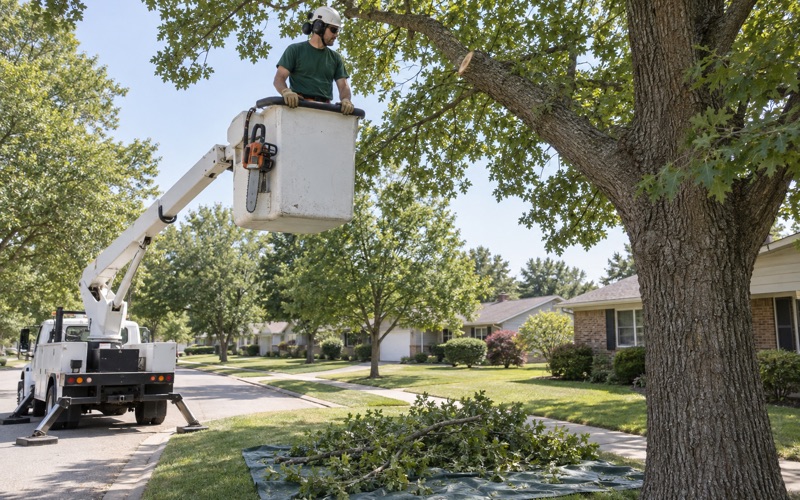
Worker steadying himself on the bucket rail while making a branch collar cut in a Blue Springs pin oak.

Tree Trimming

Structural and maintenance pruning to the ANSI A300 standard, plus cabling and bracing, across Blue Springs and the surrounding Kansas City metro.

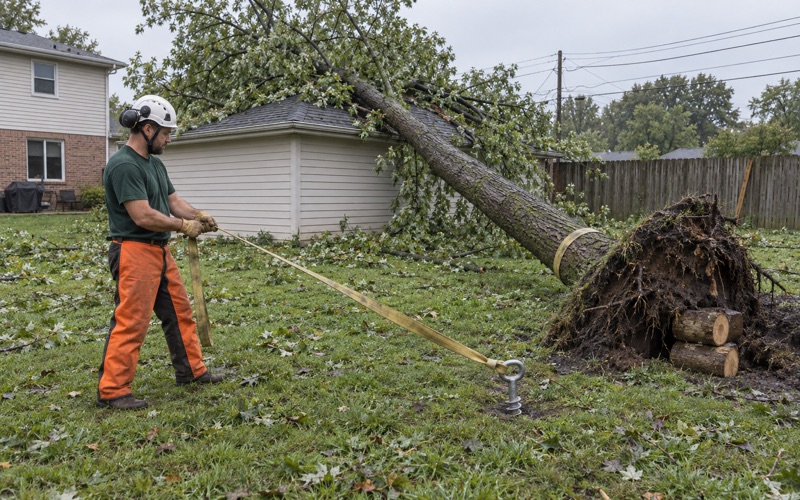
Worker setting a choker strap at the butt of a wind-thrown silver maple resting on a Blue Springs detached garage.

Emergency Tree Removal

Same-day emergency and storm damage tree removal across Blue Springs and the Kansas City metro, with the site made safe and documented first.

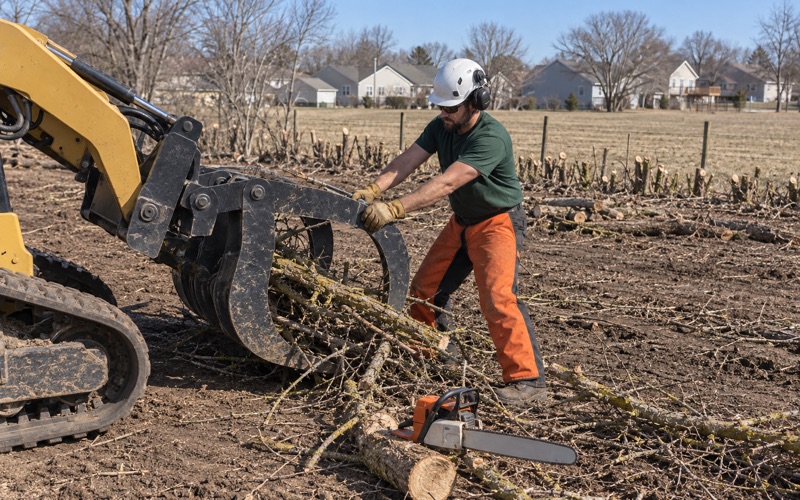
Worker steadying the grapple arm of a shut-down loader while an old Osage orange hedge row is cleared on a Blue Springs lot.

Land Clearing

Land and lot clearing, forestry mulching and invasive brush removal on acreage and building sites across Blue Springs and the Kansas City metro.

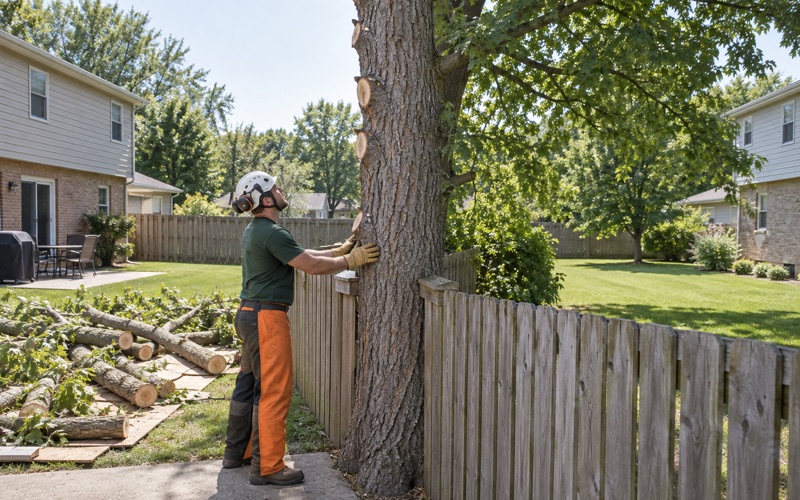
Worker at the bole of a silver maple growing on a Blue Springs property line, with the cut stopped dead at the boundary.

Neighbor Tree Removal

Property line and neighbor tree work across Blue Springs and the Kansas City metro, with the state line, the boundary and the liability sorted first.

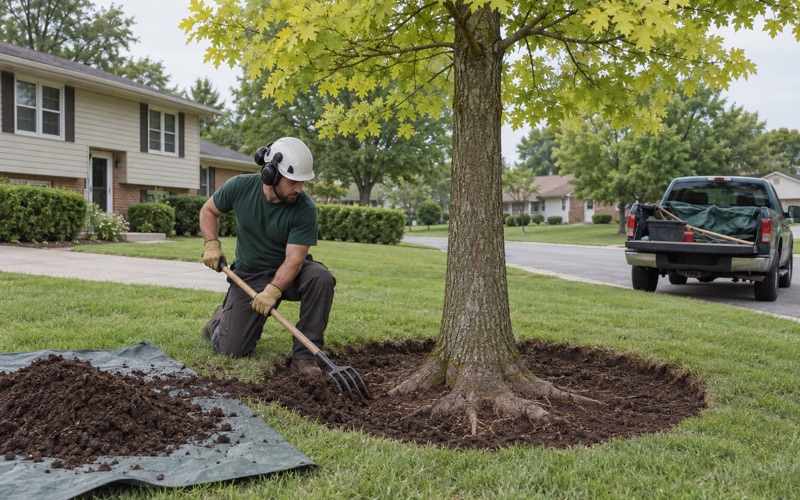
Worker easing soil back from the root flare of a chlorotic pin oak during a root collar excavation in Blue Springs.

Tree Disease Treatment

Diagnosis and treatment for pine wilt, emerald ash borer, needle blights and soil-related tree decline across Blue Springs and the Kansas City metro.

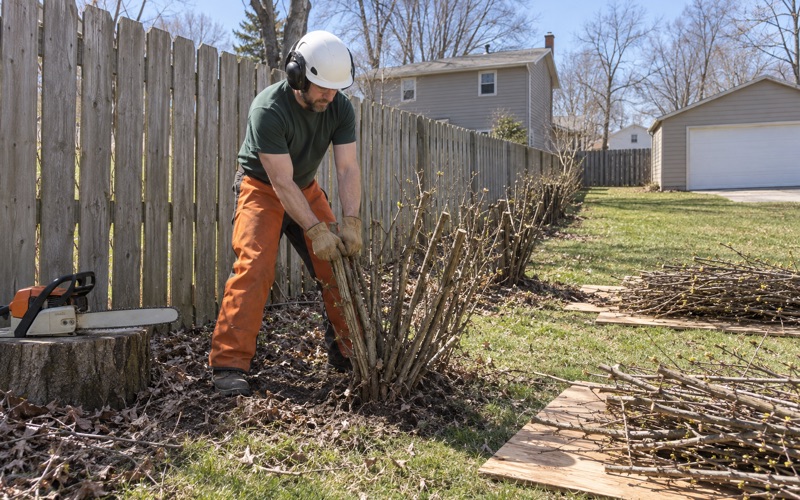
Worker pulling a cut bush honeysuckle stem cluster out of a Blue Springs rear fence line.

Brush Removal

Shrub, hedge and brush removal around homes and buildings across Blue Springs and the Kansas City metro, with everything hauled off, not curbed.

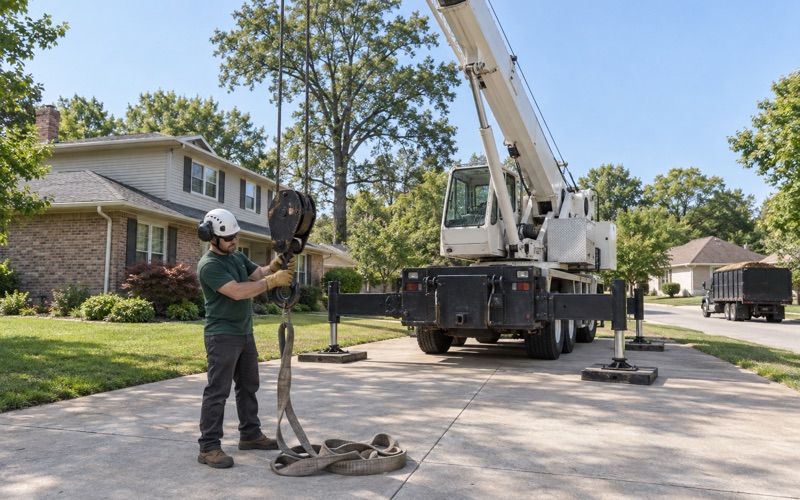
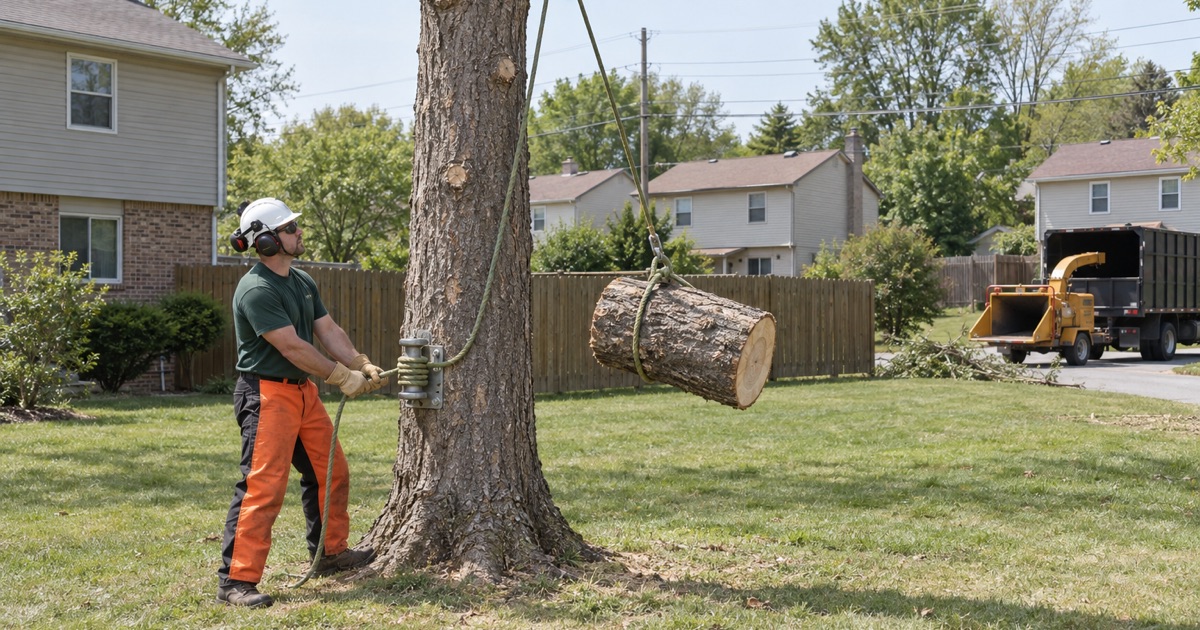
Worker seating a choker sling into the empty crane hook block on a Blue Springs driveway before a pick.

Crane Tree Removal

Crane-assisted removal for trees over houses, pools and tight lots across Blue Springs and the Kansas City metro, where rigging alone will not do.

Two Decades of Tree Work in the Kansas City Metro

Ground worker holding three wraps on the bollard while a silver maple stem section comes down in a Blue Springs back yard.

20+ Years Removing Trees on Both Sides of State Line Road

More than twenty years in this metro is the only credential claim on this page, and it is the honest one, because neither Missouri nor Kansas issues a license or a certification for tree work. There is no state card for anyone in this trade to wave. What you can check is time in the market, current liability and workers’ compensation coverage, and whether a company will put its condition assessment in writing before it quotes a number. We hand over all three without being asked.

Why Choose Blue Springs Tree Removal

Written Condition Assessment

Every quote has a written condition assessment behind it, worked against University of Missouri Extension G6867’s own decision points: whether at least half the crown is still intact, whether a wound will seal, whether a bent stem or a limb larger than six inches in diameter belongs to a more experienced crew. You see why a tree was called or spared, rather than taking a number on a card and a verbal verdict.

Two States, One Answer That Fits Your Address

No neighbor’s tree question gets a default answer here. Missouri follows the Massachusetts Rule under Hasapopoulos v. Murphy, while Kansas treats an encroaching tree as a possible nuisance under Pierce v. Casady, so we establish which side of State Line Road your problem sits on before telling you what may be cut, rather than repeating one state’s rule across a metro that runs on two.

The Debris Leaves With Us

Nothing we cut is stacked at your curb. Blue Springs runs no curbside brush program, its bundle rule stops at limbs under four inches, and RSMo 260.250 has kept yard waste out of Missouri disposal areas since 1992, so a removal’s wood and brush has to reach a composting gate and be paid for by the cubic yard. We name that destination in the quote rather than leaving it as your discovery.

Never a Topping Cut

We do not top a tree, and we explain why when somebody else offers to. Topping strips the canopy back to stubs and the tree answers with epicormic sprouts anchored in decayed wood, so you buy a weaker tree and a second bill. We prune to the ANSI A300 standard using natural target pruning, and reach for crown cleaning, raising, reduction or thinning as the structure actually calls for.

Insurance Proof Before the Crew Arrives

Certificates reach you before a truck is loaded. RSMo 537.340.1 attaches treble damages to cutting down or injuring a tree grown for use, shade or ornament, and the claimant need not prove negligence or intent, so an uninsured crew working near a boundary is your exposure as much as theirs, rather than paperwork to sort out after something goes wrong.

Emergency and Storm Tree Work

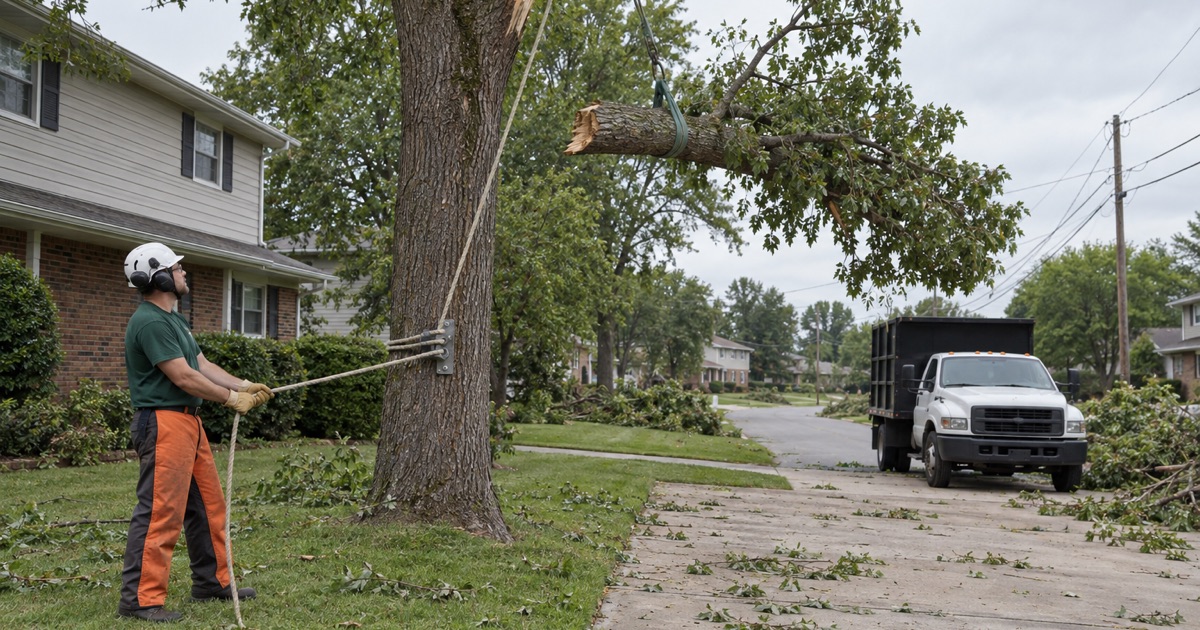
Worker holding the tail of the lowering rope while a wind-broken Siberian elm leader is brought down over a Blue Springs driveway.

First Moves After a Tree Comes Down on the House

A tree through a roof is a structure claim before it is a tree job. Clear the affected rooms, photograph everything from a safe distance, and call your homeowners carrier before anything is cut, because the Missouri Department of Commerce and Insurance states that homeowners coverage pays toward removing a tree that damages your home or other insured property. We tarp, relieve load and document before we start cutting.

A Tree on Your Car Is an Auto Claim, Not a Homeowners Claim

The same Missouri regulator guidance is explicit that comprehensive auto coverage is what pays for a car damaged by a falling tree, so the call goes to your auto carrier rather than the homeowners adjuster already on the phone. We separate the vehicle from the rest of the debris field first, cut it free without dragging the trunk across the panels, and photograph the sequence so the two claims do not collide.

Tree on a Power Line: Who to Call Before Anyone Goes Near It

Evergy’s own instruction is to stay at least thirty feet away, touch nothing in contact with the line, call 911 first and then Evergy at 888-544-4852. Its safety page is equally direct that you must not remove a limb or any other object from a power line, because electricity travels through objects and travels better when they are wet. We do not touch that tree either until the utility has cleared it.

Storm Debris Cleanup After a Kansas City Wind Storm

The National Weather Service office at Pleasant Hill titles this metro’s damaging events wind storms, squall lines and downbursts, and its own event list includes the July 14, 2023 wind storm that left widespread power outages across Kansas City. Debris from one of those is volume work rather than a single removal, so we quote it by what has to leave the property and where the nearest gate will accept it.

Ice Loading, and What a Tree Actually Recovers From

The February 5 to 7, 2019 ice storm reached an eighth to a quarter inch of accretion across eastern Kansas and central Missouri, which is enough to bend and shed limbs without killing the tree underneath. University of Missouri Extension G6867 gives the line worth knowing: a two to three inch wound on a twelve inch limb will seal over, but a crown more than half gone has lost its survival edge.

Emergency Triage: Five Calls in the Right Sequence

A downed conductor takes 911 first and then Evergy at 888-544-4852, while a tree across a city street goes to the Blue Springs Streets Division at (816) 228-0195 between 7:30 a.m. and 4:00 p.m., or to the police non-emergency line outside those hours. A tree across a numbered state route belongs to MoDOT at 1-888-ASK-MoDOT, a tree on the house goes to your homeowners carrier, and a tree on the car goes to your auto carrier. We come after whichever of those applies, and almost nobody in this trade hands you the order as one list.

A Downed Limb and a Downed Conductor Are Not the Same Job

A limb lying across your driveway is a Saturday morning; a limb lying across a service drop is a utility matter with a specific owner. Evergy treats the line running from the pole to your meter as the customer’s responsibility but runs an assist that normally removes overhanging branches and limbs within ten feet of energized conductors, leaving the debris at the worksite. We handle that debris; we do not handle the conductor.

Why a Crew Comes Down Out of a Tree in High Wind

Climbing and rigging under the ANSI Z133 safety standard means a climber, a rope, a Port-a-Wrap friction device and a groundsman all working inside a known working load limit. Gusts move a loaded limb unpredictably against that limit and put the drop zone somewhere nobody planned, so our crews come down and wait rather than finishing a cut on a schedule.

Same-Day Hazard Response and How It Is Priced

A tree on a roof, a car, or a line gets a same-day response from us, and the first visit is a make-safe visit rather than the whole removal. It is priced as its own job because it is one: stabilization, load relief, tarping and documentation, with the full removal quoted separately once the structure has been seen and the claim has a paper trail behind it.

Tree Removal, Permits and Property Lines

Worker checking a protection barrier around a retained pin oak on a Blue Springs development lot.

Do You Need a Permit to Take Down a Tree Here

On a finished private lot in Blue Springs, no. Chapter 240 of the city code runs from Section 240.010 through Section 240.080 with no permit section anywhere in it, and Section 240.020 defines a tree for that chapter’s purposes as one at least two inches in diameter at a height of four feet above the ground. Neighboring municipalities answer differently, which is why we check the address rather than the metro.

Missouri and Kansas Answer the Neighbor’s Tree Question Differently

Missouri applies the Massachusetts Rule, under which healthy encroaching roots and branches give no cause of action and the complaining owner keeps only a right of self-protection by cutting back to the property line at their own cost, which is the holding in Hasapopoulos v. Murphy. Kansas reaches the same fence through nuisance instead, under Pierce v. Casady, so one tree can leave you with two different starting positions twenty minutes apart.

Overhanging Branches and What Cutting to the Line Really Allows

Self-help stops at the boundary plane, and it is help rather than license: you may cut what crosses onto your side, at your expense, and you take the risk if the cut kills the tree. That is where RSMo 537.340.1 becomes a live problem, since treble damages for injuring a tree grown for use, shade or ornament do not require the claimant to prove negligence or intent.

When a Neighbor Can Be Made to Deal With Their Tree

A healthy tree dropping leaves, fruit or shade over the fence is not something you can compel anyone to remove under either state’s rule. What changes the conversation is condition, not inconvenience, and condition is a documented question rather than an argued one. A written assessment naming decay, a compromised root plate or a failing union is the instrument that moves a neighbor, an association or an insurer.

When a Decayed Tree Becomes the Owner’s Problem

Liability attaches where an owner keeps a tree in a damaged, decayed or diseased condition and it then causes harm, which is a different test from the healthy-tree rule above. Conks at the base, heartwood decay, a lifting root plate and a bark-included union are the observable signs, and once they are recorded and dated, an owner who does nothing is choosing a known risk instead of an unknown one.

Street Trees, Utility Easements and Who Owns What

Blue Springs Section 240.030 runs the opposite way to how it is usually described: it makes it unlawful to remove, damage, alter, trim or cut a tree in a public utility easement without the written permission of the property owner. The utility may still prune within six feet of its lines, may cut to the ground a trunk lying wholly within the easement, and must give notice not more than eight weeks nor less than two weeks in advance.

A Tree Near an Airport Is a Regulated Obstruction

On the Kansas side of this metro, the Uniform Airport Zoning Act at K.S.A. 3-701 through 3-713 lets a city zone height around an airport, and subdivisions inside an airport interest area can carry a dedicated avigation easement that limits how tall anything on the lot may grow. If your plat has one, the height of a tree is a compliance question, and it is answered from the recorded document rather than from the yard.

Neither Missouri Nor Kansas Licenses Tree Work, So What Do You Check

There is no state tree contractor license on either side of the line. The only relevant Missouri state credential is the Department of Agriculture Commercial Applicator certification, Category 3, Ornamental and Turf, under RSMo Chapter 281, and even the Missouri Department of Conservation’s guidance on hiring an arborist never uses the word licensed. Check insurance certificates, ISA certification held by the crew, and a written scope.

What an Arborist Report Is Actually For

An arborist report is the document that turns a suspicion into a dated, defensible record: species, diameter at breast height, observed defects, the tree risk assessment behind the conclusion, and a recommendation. Insurers, associations, neighbors and municipal staff all respond to it differently than they respond to a phone call, which is why we write one before recommending removal on a tree anybody is likely to argue about.
Trimming, Pruning and Tree Health

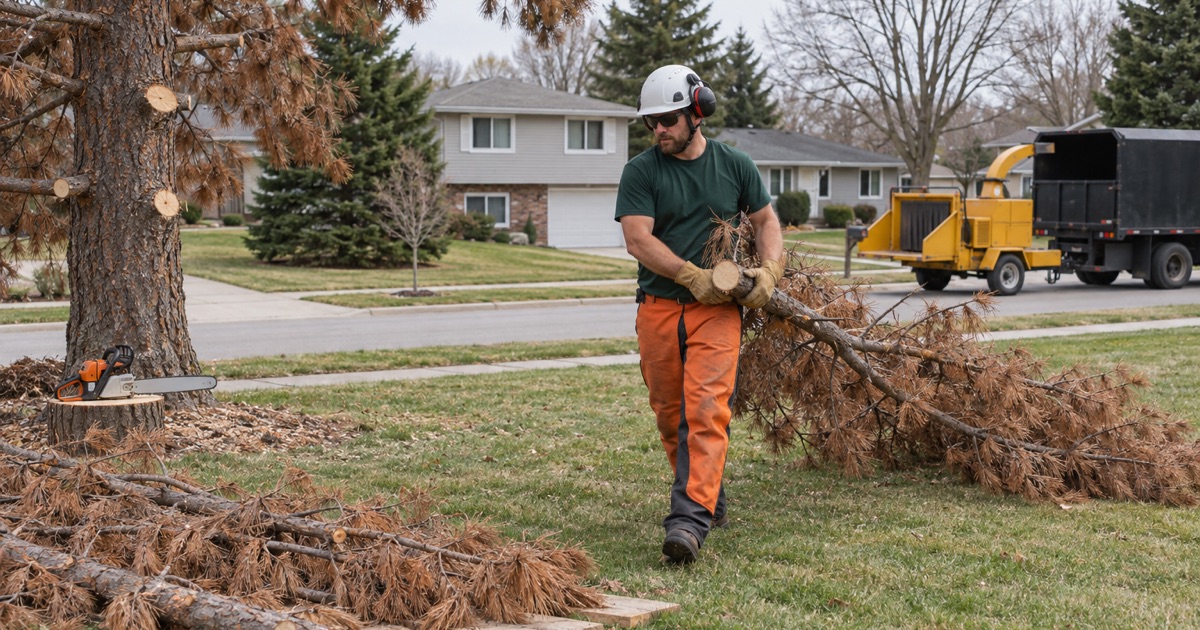
Worker carrying a cut limb butt clear after taking down a pine-wilt-killed Austrian pine in a Blue Springs front yard.

Cleaning, Raising, Reduction and Thinning: The Four Pruning Jobs

The ANSI A300 standard separates crown cleaning, which takes out dead, diseased and broken wood; crown raising, which lifts the lowest limbs off a roof, a drive or a sidewalk; crown reduction, which shortens leaders back to a suitable lateral; and crown thinning, which opens the canopy to wind. Naming which one your tree needs is most of the job, and the cuts themselves are natural target pruning either way.

Cabling and Bracing Instead of Removal

Co-dominant stems with included bark are the classic candidate: two leaders of similar size joined by a union with bark trapped inside it, holding until the day it does not. Extra-high-strength cable or a Cobra dynamic cabling system installed above the union redistributes the load, and a brace rod carries a split leader that has already moved. It buys years on a tree worth keeping.

Pine Wilt Is the One Removal With a Deadline

Kansas State Research and Extension publication L722 records that Scots pine plantings in eastern Kansas have been devastated by pine wilt, and its instructions carry a calendar nothing else in this trade does: cut the tree down as soon as possible or by May 1 at the latest, with April 1 better; cut it to the ground and leave no stump; chip or burn the wood immediately; and do not save it for firewood.

Bradford Pear Splits at Ten to Fifteen Years Old

K-State Research and Extension’s Johnson County guide for metropolitan Kansas City instructs, in terms, do not plant the Bradford cultivar, because severe splitting occurs on trees ten to fifteen years old. The tree is structurally committed to failure by its own branch angles, so once one leader has gone the usual honest answer is removal rather than a reduction that buys one more season.

Emerald Ash Borer, and Why a Dead Ash Goes Brittle

Emerald ash borer was found in Missouri in July 2008 in Wayne County, and the federal domestic quarantine was lifted effective January 14, 2021. What matters operationally is the wood: an ash killed by borer damage dries hard and lets go without warning, which turns a routine climb into a rigging problem. Dead ash is a job to schedule early rather than defer, and green ash is on K-State’s not-recommended list for this area.

Root Collar Excavation and Air Spading

A root flare buried by grade changes, mulch volcanoes or settled beds sits wet and dark against the trunk and rots quietly for years. Pneumatic soil excavation with an air spade lifts that soil away without severing roots, so the flare can be inspected and the collar left exposed. Radial trenching through the same tool relieves compaction where a root plate is failing to breathe.

The Trees Extension Services Tell You Not to Plant Here

The K-State Johnson County list of trees not recommended for the Kansas City area is short and specific: silver maple for weak wood, pin oak for soil issues, green ash for emerald ash borer, Austrian pine, Scotch pine, box elder, Bradford pear, Lombardy poplar, Siberian elm and willow. Much of the removal demand in this metro sits on exactly that list, planted decades before anybody published it.

Deep Root Fertilization and Soil Treatment

Compacted lawn soil is the limiting factor for most struggling yard trees long before any pest is. Deep root fertilization injects nutrient and amendment below the turf zone where the feeder roots actually are, and a tree growth regulator can slow top growth so a stressed tree spends its budget on roots instead. Neither is a substitute for a diagnosis, which is why we soil-check before we treat.

The Signs a Tree Is Failing Before It Falls

Evergy publishes the same list its own inspectors work from: dead or dying wood, severe lean, weak branches, root failure, cankers, conks and internal decay. Add epicormic sprouts along a trunk, a root plate lifting on one side, and a seam opening at a union. Any one of them is a reason for a tree risk assessment; two together usually means the assessment is overdue.

Stumps, Debris and Land Clearing

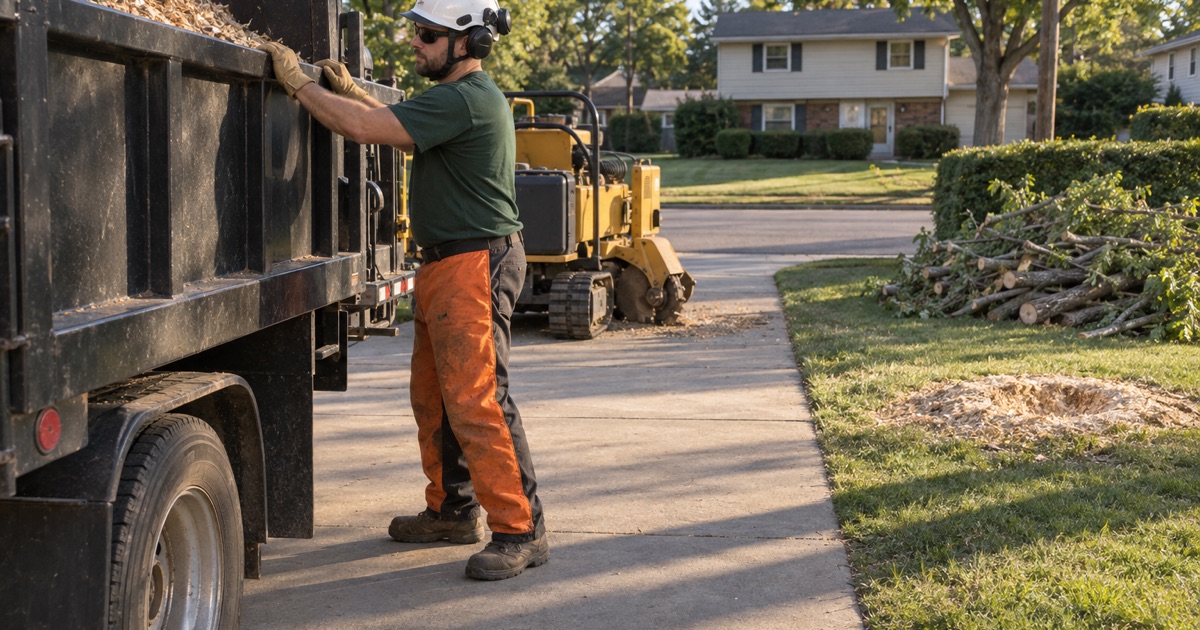
Worker at the side of the chip box on a Blue Springs driveway apron after a boxelder removal and stump grind.

Grinding a Stump Versus Digging It Out

A stump grinder tooth wheel chews the stump and its buttress roots into chips in place, leaving a cavity that backfills and turfs over. Excavation pulls the root plate whole, which is what a builder needs before a footing goes in and what nobody needs before a lawn goes back. Grinding is faster, cheaper and less destructive to the surrounding ground, so it is the default unless the plan says otherwise.

How Deep a Stump Grinder Actually Goes

Machines in this class are rated for a below-grade cut depth in the range of twelve to twenty-five inches, and the soil here is not what stops them. The Sibley series that has its type location in Jackson County carries a solum typically fifty to sixty inches deep, so the machine’s own limit binds first. We still quote the depth from the stump in front of us, because a per-lot answer is the only honest one.

What Happens to the Pile of Grindings

Grindings are a mound of wood chips and soil, and they mound higher than the hole they came from. Left in place they settle for a season, hold nitrogen away from new grass and sprout mushrooms; hauled away they are a truck movement with a gate fee. We ask which you want before we grind, because raking them level and taking them away are two different prices.

Where the Wood Goes, and What the Gate Charges

Missouri Organic Recycling runs the commercial composting gates in this market and publishes its rates: two dollars per bag, ten dollars per cubic yard of brush and seven dollars per cubic yard of lawn debris. It takes brush and logs under ten feet in length and logs up to forty inches in diameter if under five feet long, and it refuses stumps with dirt on them. Those limits shape the cut list, not just the bill.

Brush Programs and Their Diameter Caps, City by City

Blue Springs runs no curbside brush program at all and routes residents outward, to the Jackson County center at 816-847-7050, to Missouri Organic Recycling at 816-483-0908 and to the Lee’s Summit Resource Recovery Park. Where a curbside program does exist across this metro the cap is usually a diameter, and the caps differ enough between neighboring cities that they have to be checked by address.

The Firewood Credit Is a Line Item, Not a Favor

If you want the trunk left in rounds, say so at the assessment and it comes off the disposal side of the quote as a stated credit rather than appearing as goodwill. It is not free: rounds have to be cut to a length you can handle and stacked where you want them, and that is crew time. Showing it as a line keeps the quote readable when you compare it with somebody else’s.

Lot Clearing and Forestry Mulching

On a building lot, forestry mulching grinds standing brush and small stems into a mulch layer in place, which avoids the haul cost entirely and leaves erosion protection behind. It is the wrong tool where the plan calls for a clean subgrade or where stems exceed what the head will take, and in that case we clear conventionally and route the material to a gate. The site plan decides, not the machine.

Bush Honeysuckle and Invasive Brush Removal

Bush honeysuckle takes a fence line or a wood edge and holds it by leafing out first and dropping leaves last, shading out everything underneath. Cutting alone regrows from the stump, so removal means cutting and treating the cut surface, then coming back for the seed bank. It is volume work rather than tree work, and it is quoted by the area cleared rather than by the stem.

Old Hedge Rows and Osage Orange

The hedge tree, Osage orange, was planted as living fence across this part of Missouri and Kansas long before wire was cheap, and the rows are still there behind newer subdivisions. The wood is dense, thorny and hard on chain, the stems are usually multi-trunked from decades of cutting, and the row is often a property line. We survey it before quoting, because clearing one is a boundary question as much as a brush question.

Areas We Serve

Blue Springs Tree Removal provides tree-removal throughout the greater Blue Springs area, with the same crews and the same standards on every job.

Good to know

Frequently Asked Questions

Do I need a permit to remove a tree in Blue Springs?

Not on a finished private lot. Chapter 240 of the city code, Tree Trimming and Maintenance, runs from Section 240.010 through Section 240.080 and contains no permit section at all. Tree preservation in Blue Springs is a development requirement instead, living in the Unified Development Code at Section 407.040, where existing trees earn credit units by diameter and preserved root zones have to be protected from construction activity. If your lot is already built on, the ordinance does not stand between you and the removal.

Will you top my tree to get it down to a safer height?

No, and we will explain why on site rather than quietly substituting something else. Topping cuts limbs back to stubs, removes the canopy the tree feeds itself with, and forces a flush of epicormic sprouts anchored in wood that is already decaying, so the regrowth is weaker than what you removed and arrives faster. Where height or weight is genuinely the problem we price crown reduction to the ANSI A300 standard, or cabling and bracing to hold a defect together.

What does a tree removal cost, and how is the price set?

We do not publish a per-tree figure, because the four things that actually move a price are lot-specific: how much of the tree can be dropped versus rigged down, what sits under the drop zone, whether a crane or a chipper can reach the trunk, and how far the debris has to travel to a gate that will take it. The on-site assessment is free, the quote is written, and the disposal routing is named in it rather than added afterward.

Is a tree service licensed by the state of Missouri or Kansas?

Neither state licenses or certifies tree work, so nobody in this trade can hand you a state tree card. Missouri's only related state credential is the Department of Agriculture Commercial Applicator certification, Category 3, Ornamental and Turf, under RSMo Chapter 281, and the Missouri Department of Conservation's own guidance on hiring an arborist never uses the word licensed. What you check instead is current liability and workers' compensation coverage, ISA certification held by the people doing the work, and written terms.

How soon can you get to a tree that is on my house or blocking my driveway?

Same-day response is what we hold ourselves to when a tree is on a roof, on a vehicle, or across the only way out of a property. The first visit is stabilization and making the site safe, which is often a tarp, a cut to relieve load, and photographs for the claim; the full removal follows once the structure is documented and the weather allows a crew to work aloft safely.

Do you take the wood and brush away, or does it stay on my property?

It leaves with us unless you ask to keep it. Blue Springs runs no curbside brush program, and the city's own bundle rule stops at limbs under four inches tied into bundles no longer than forty-eight inches and under seventy-five pounds, which no removal produces. Under RSMo 260.250 yard waste has been barred from Missouri disposal areas since 1992, so removal wood goes to a composting gate priced by the cubic yard, and that cost is a named line in your quote.

Can you save my tree instead of removing it?

Often, and we would rather tell you so before you have paid for a removal. Cabling and bracing holds co-dominant stems with included bark together, structural pruning corrects a split leader while it is still correctable, and root collar excavation with an air spade can uncover a buried root flare that is strangling a tree nobody diagnosed. Where the crown is more than half gone, University of Missouri Extension G6867 is blunt that the tree has lost its survival edge, and we say so.

Do you work in Kansas as well as Missouri?

Yes, and knowing where the state line falls is part of the service rather than a coverage note. The rule governing a neighbor's overhanging branches differs between the two states, city permit and licensing requirements vary from one municipality to the next across this metro, and the disposal gate that will accept your removal wood depends on which county you are in. We answer for the address, not for the region.

What kind of insurance should I ask a tree company for before work starts?

General liability and workers' compensation, both current, and sent to you rather than described to you. It matters more in this trade than most, because RSMo 537.340.1 attaches treble damages to cutting down or injuring a tree grown for use, shade or ornament and the claimant does not have to prove negligence or intent, so a mistake on a boundary tree is expensive. Our certificates reach you before a crew is scheduled.

How long does a typical removal and stump grinding job take?

Most single-tree residential removals are a one-day job, and grinding the stump is frequently a separate short visit because the grinder is a different machine on a different trailer. Crane-assisted removals over a house or a pool take longer to set up than to cut. Before any grinding we file a locate request with Missouri 811, which state law requires at least three and not more than ten working days ahead, and that notice window is usually what sets the date.

Ready to Get Started?

Request a free quote today and we'll get back to you fast.